What Changes for Teacher Training Courses?
As the European Commission officially published its proposal for the next Erasmus+ programme (2028–2034) in July 2025. For schools, teachers, and education staff across Europe, this is genuinely big news. Here's what's coming — and what it means for the people who plan, teach, and apply.
A bigger budget for education
The proposed Erasmus+ 2028–2034 budget sits at €40.8 billion — roughly a 30% jump compared to what the current Erasmus+ and European Solidarity Corps (ESC) programmes receive together. Annual allocation rises from €5.26 billion in 2028 to €6.44 billion by 2034.
The signal is clear: Europe is doubling down on education as a driver of competitiveness and social cohesion. The money is real, and so is the intent.
Teacher training still remains at the core
Good news for teachers: structured courses and job shadowing abroad are explicitly preserved. The Commission's proposal lifts learning mobility for education staff into a fundamental part of the programme. Teachers, school staff, trainers, and adult educators are all named beneficiaries under the new "Learning Opportunities for All" pillar — alongside students, volunteers, and athletes.
A new two-pillar structure
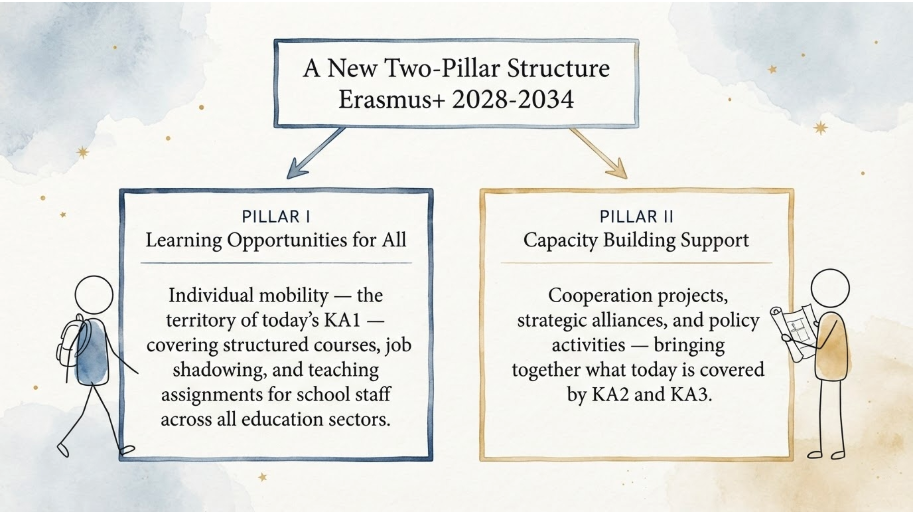
The programme is being reorganised around two pillars:
Learning Opportunities for All — individual mobility, what we currently know as KA1. That means structured courses, job shadowing, and teaching assignments for school staff across all education sectors.
Capacity Building Support — cooperation projects, alliances, and policy activities. Today, this is the territory covered by KA2 and KA3.
European Parliament Think Tank, A reworked Erasmus+ for 2028–2034, February 2026
What's new for teachers
A few things are important to mention:
More flexible and blended formats — short-term and blended mobility options are being expanded so staff who can't be away for longer stretches can still take part.
Micro-credentials — continuing professional development is supported through flexible, formally recognised pathways, aligned with EU Council recommendations.
New content priorities — training in AI, digital skills, green education, and inclusion will be prioritised and better funded. This maps directly onto the EU's "Union of Skills" agenda.
Simpler applications — the proposal commits to reducing bureaucracy, with simplified processes and flat-rate grants aimed at helping smaller schools actually access the funding.
European Teacher Academies — these transnational professional development networks will be strengthened under the Capacity Building pillar, opening up new collaborative formats for teacher training at the European level.
The four core priorities Stays!
Inclusion and diversity — reaching learners and staff with fewer opportunities.
Digital transformation — AI in education, digital skills, smart tools.
Environment and climate — green competences, sustainable practices.
Democratic participation — civic engagement, EU values, media literacy.
EPALE – European Commission; European Commission, COM(2025) 549
What this means for you, right now
The new programme doesn't begin until 2028. That’s a thought for later.
Until then, Erasmus+ KA1 continues exactly as you know it — and structured Erasmus+ teacher training courses keep running on the same rhythm, the same rules, the same deadlines. Think of it as the system getting a bigger sibling. Nothing stops; your runway just got longer. Time to take off!
Use the time well. Read the Programme Guide cover to cover, line up your school calendars now, and sketch out what a 2028-application year would look like for your school.
As the proposal makes its way through over the coming months, we'll keep updating this space with what changes, what holds, and what teachers and schools need to do next.