The Power of Intercultural & Diverse Learning Environments
Classrooms today are more and more shaped by cultural diversity, different languages, varied learning styles and constant exposure to the digital world. Social media, fast information and dopamine-driven platforms influence how young people relate to themselves and others, often increasing anxiety, comparison, impulsivity and shallow interactions.
Intercultural and diverse learning environments, when designed intentionally, help students and learners develop deeper social skills: critical thinking, teamwork, communication, empathy and respect. They create spaces where differences are a strength rather than a barrier, and where neurodivergent learners and students from different backgrounds can participate more fully.
This course is designed for educators in formal, non-formal and informal settings who want to build healthier, more collaborative and more inclusive learning environments. It focuses on practical strategies to strengthen social skills, address digital-age challenges and support diverse and neurodivergent learners in everyday educational practice.
Recent estimates suggest that around 15–20% of the global population can be described as neurodivergent, including learners with ADHD, autism, dyslexia and other profiles. This course helps educators design environments that recognise and support these differences.
Why This Course Matters
What Participants Learn
Use non-formal education techniques to make formal learning more participatory, inclusive and engaging.
- Facilitate intercultural collaboration and dismantle communication barriers in diverse classrooms and groups.
- Address how social media, fast content and dopamine-driven digital habits affect attention, empathy and social skills.
- Design activities that strengthen teamwork, communication, critical thinking and perspective-taking.
- Apply mediation and negotiation tools to prevent and resolve conflicts, misunderstandings and exclusion.
- Recognise neurodiversity and design learning experiences that are more accessible and supportive for neurodivergent learners.
- Use simple digital tools to support collaboration and exchange without increasing stress or distraction.
- Build cohesive teams through dynamic group activities, feedback systems and shared responsibility.
- Develop action plans for cross-cultural projects and intercultural initiatives under the Erasmus+ framework.
How the Course Works
- Interactive workshops: role-playing, simulations and co-creation of resources for diverse learning environments.
- Cross-cultural exchanges: sharing best practices from different European contexts and educational settings.
- Case studies and reflection: analysing real-world scenarios to refine teaching approaches, social skills work and conflict resolution.
- Collaborative problem-solving: group tasks to address dropout risks, miscommunication, digital-age challenges and resistance to change.
- Digital integration: using simple, purposeful tools for communication and collaboration without overwhelming learners.
- A supportive, fun atmosphere that helps participants experiment, reflect and leave with both new skills and renewed enthusiasm.
-
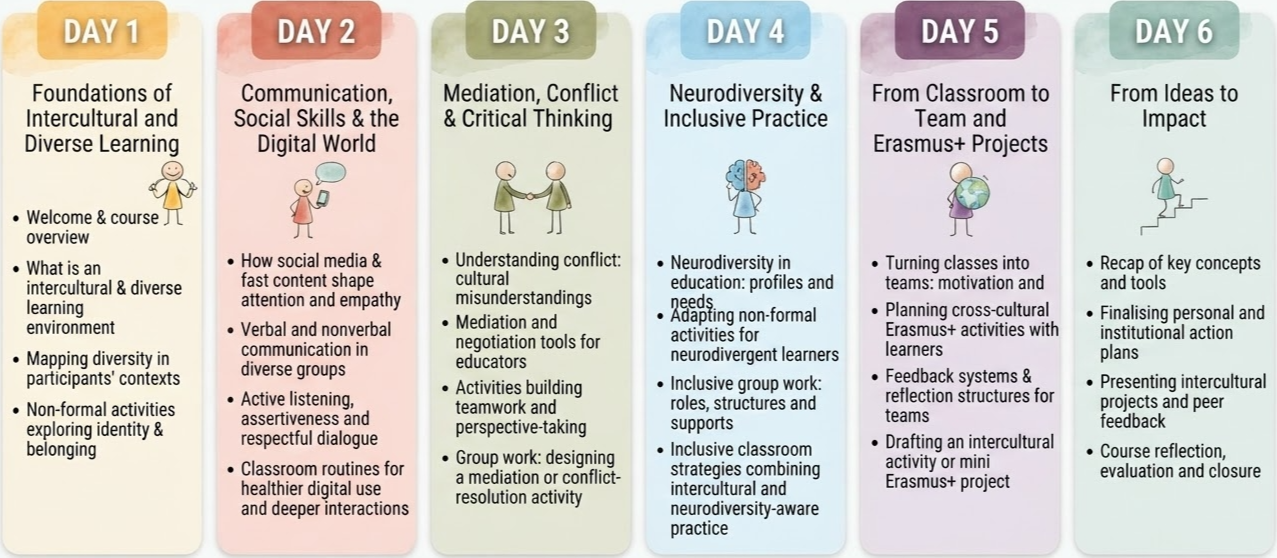
09:00–09:30 | Welcome, course overview and introductions
09:30–10:15 | What is an intercultural and diverse learning environment?
10:15–10:30 | Coffee break
10:30–11:30 | Mapping diversity in participants’ contexts (languages, cultures, identities, neurodiversity)
11:30–12:30 | Non-formal activities to explore identity and belonging
12:30–13:30 | Reflection and group sharing: why intercultural work matters now
-
09:00–09:30 | Recap and warm-up activity
09:30–10:15 | How social media, fast content and dopamine habits influence attention, empathy and social skills
10:15–10:30 | Coffee break
10:30–11:30 | Communication styles: verbal and nonverbal communication in diverse groups
11:30–12:30 | Activities to strengthen active listening, assertiveness and respectful dialogue
12:30–13:30 | Designing simple classroom routines to support healthier digital use and deeper interactions
-
09:00–09:30 | Recap and check-in
09:30–10:15 | Understanding conflict: cultural misunderstandings, miscommunication and group dynamics
10:15–10:30 | Coffee break
10:30–11:30 | Mediation and negotiation tools for educators working with diverse groups
11:30–12:30 | Activities that build teamwork, critical thinking and perspective-taking through intercultural scenarios
12:30–13:30 | Group work: designing a mediation or conflict-resolution activity for participants’ own contexts
-
09:00–09:30 | Recap and sharing
09:30–10:15 | Neurodiversity in education: understanding different profiles and needs
10:15–10:30 | Coffee break
10:30–11:30 | Adapting non-formal activities to support neurodivergent learners and diverse participation
11:30–12:30 | Inclusive group work: roles, structures and supports that help everyone contribute
12:30–13:30 | Designing inclusive classroom strategies that combine intercultural and neurodiversity-aware practice
-
09:00–09:30 | Recap and energiser
09:30–10:15 | Turning classes into teams: motivation, shared responsibility and group identity
10:15–10:30 | Coffee break
10:30–11:30 | Planning cross-cultural projects and activities under Erasmus+ that involve learners actively
11:30–12:30 | Feedback systems and reflection structures that keep teams connected and learning
12:30–13:30 | Group work: drafting an intercultural activity or mini-project ready to integrate into an Erasmus+ plan
-
09:00–09:30 | Recap of key concepts and tools
09:30–10:15 | Finalising personal and institutional action plans
10:15–10:30 | Coffee break
10:30–11:30 | Presenting intercultural and diverse learning projects or activity outlines; peer feedback
11:30–12:30 | Identifying opportunities for collaboration and follow-up under Erasmus+
12:30–13:30 | Course reflection, evaluation and closure
What Participants Take Back
- Enhanced ability to manage diverse and intercultural classrooms with empathy and cultural sensitivity.
- Practical non-formal activities that transform groups into collaborative teams and strengthen social skills.
- Strategies to address miscommunication, conflicts, social exclusion and student disengagement in everyday practice.
- Ideas and action plans for Erasmus+ projects and intercultural initiatives that involve learners meaningfully.
- A toolkit of activities and simple digital resources for dynamic group work, reflection and collaboration.
- Greater confidence in leading cross-border educational partnerships and working with diverse European teams.
- A clearer understanding of how the digital world impacts youth behaviour and social skills, and practical ways to respond through intercultural education.
Course Format
- Duration: one-week course (5-6 training days). Alternative formats may be available on request.
- Daily workload: 5-6 hours per day, from 09:00 to 14:00, with one coffee break and several short transitions between activities.
- Language: English.
- Language requirement: participants should have at least an A2/B1 level of English to actively follow the training and take part in discussions and practical work.
- Digital level: no specific digital skills are required. This course focuses on dialogue, group work, and activity-based methods rather than digital tools.
- Equipment: participants are not required to bring laptops or tablets. Materials needed for activities (paper, markers, cards, etc.) are provided
- Target groups: teachers, trainers, youth workers, adult educators, school leaders, and other education professionals.
- Adaptation: examples and activities are adapted to participants’ areas of work, age groups and institutional contexts whenever possible.
- Funding fit: this course is designed to align with Erasmus+ KA1 staff mobility funding for SCH, ADU and VET participants, according to their approved budget and funding rules.
Course Fee
€80 per participant, per training day
This course fee is designed to align with Erasmus+ KA1 staff mobility funding for eligible SCH, ADU and VET participants.
What is Included:
✔Erasmus+ Fundable: eligible for KA1 grants
✔Flexibility Guaranteed: easy changes with minimal restrictions
✔Full experience: coffee breaks to cultural visits
✔ Certificate of attendance: 5 hours per day, 30h total
Post-Course Training: 80€ voucher on 18+ courses
Travel and Stay Support
We support participants with practical guidance before arrival so they can organise their mobility with more confidence.
We suggest:
✔Accommodation options such as hotels and apartments,
✔Local transportation information, and, airport transfer options,
✔ Half-day and full-day trip ideas, cultural activities and useful local recommendations.
These services are not directly provided by Colony of Creators unless explicitly confirmed in advance, but we do help participants identify the most suitable options for their stay and make the most of their Erasmus+ experience.
100% funded by the Erasmus Plus Program through your Erasmus+ SCH, ADU or VET grant.
Eligible institutions may use Erasmus+ KA1 mobility funding to cover course-related costs according to their approved budget and funding rules.
Request Information About This Erasmus+ Course
If you are a teacher, trainer, school leader or Erasmus+ coordinator interested in Smart Teaching: AI-Driven Solutions with ChatGPT and Beyond, use this form to request course details, dates, group options or support for Erasmus+ planning.