Game On! Emotional, Social and Cognitive Growth Through Play
Play is often underestimated as a recreational activity, but it is a vital educational tool that nurtures emotional, social and cognitive development.
Through play, children and learners explore identities, express themselves and build meaningful connections with others.
Play encourages communication, cooperation and respect for shared rules, while fostering self-regulation, concentration and emotional growth.
This course guides educators in using play as a dynamic teaching method to enhance personal development in students. By incorporating different types of games – uninhibited, expressive and relaxing – teachers can create more cohesive, engaging and emotionally supportive classroom environments.
The focus is on building trust, creativity and communication through play, promoting social and emotional intelligence and helping students better understand themselves and their peers.
By playing the games themselves, participants engage in hands-on learning and experience the impact of play directly.
The course equips educators with practical tools to use play effectively to foster personal and social growth in their classrooms.
Why This Course Matters

What Participants Learn
- Understand how different types of play (uninhibited, expressive, relaxing) support emotional, social, and cognitive development.
- Use games intentionally to nurture creativity, self-expression, and emotional growth in learners.
- Read and manage group dynamics more confidently in playful and non-formal settings.
- Design and facilitate games that build cooperation, trust, and communication in diverse classrooms.
- Align gameplay with specific learning goals and the unique needs, ages, and profiles of their students.
- Use play as a practical tool to mediate conflicts, reduce tension, and guide constructive resolution.
- Encourage positive interactions and teach emotional regulation through thoughtfully designed games and routines.
How the Course Works
Interactive and practical activities:
Participants actively play different games to experience their impact on emotions, group dynamics, and behaviour.
Observation and analysis:
Teachers observe how specific games influence trust, communication, self-regulation, and collaboration.
Discussion and reflection:
Guided discussions link the experience of play to classroom realities and explore how to integrate games in a safe, purposeful way.
Game design:
Participants design their own games and adaptations tailored to their students’ ages, needs and learning goals.
Immediate application:
Throughout the course, educators translate playful strategies into concrete ideas they can use in their own lessons and programmes.
-
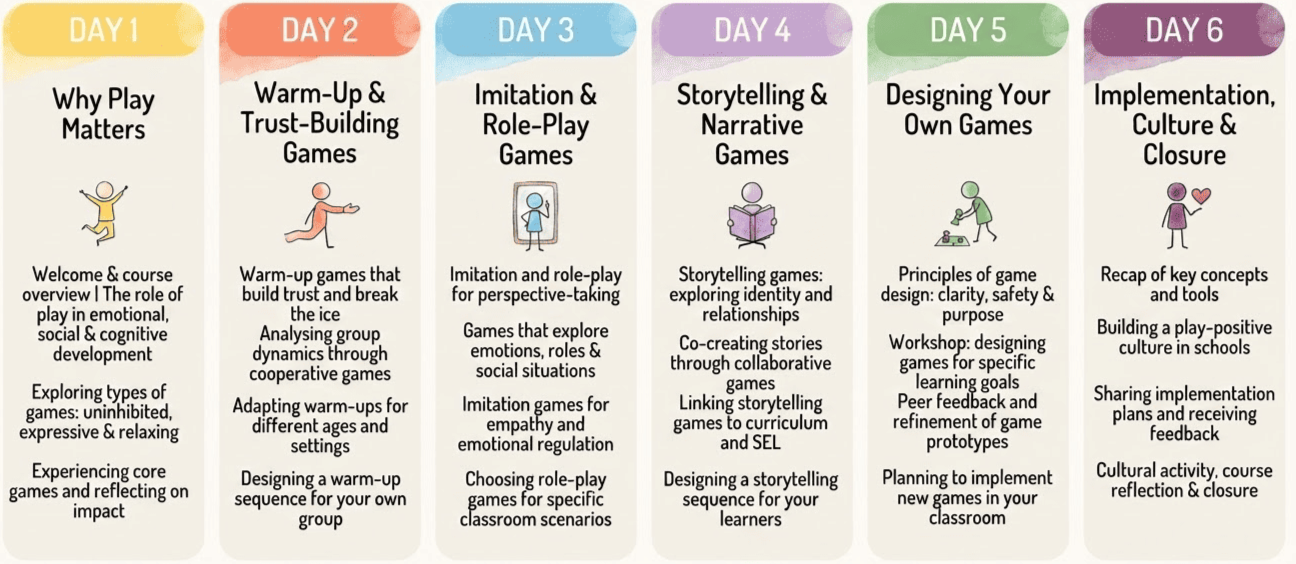
09:00–09:30 | Welcome, course overview and introductions
09:30–10:15 | The role of play in emotional, social and cognitive development
10:15–10:30 | Coffee break
10:30–11:30 | Exploring different types of games: uninhibited, expressive and relaxing
11:30–12:30 | Activity: experiencing core games and reflecting on their impact
12:30–13:30 | Group discussion: where play fits in participants’ current practice
-
09:00–09:30 | Recap and energiser
09:30–10:15 | Warm-up games that build trust and break the ice
10:15–10:30 | Coffee break
10:30–11:30 | Analysing group dynamics through simple cooperative games
11:30–12:30 | Adapting warm-up activities for different ages and settings
12:30–13:30 | Reflection: designing a warm-up sequence for your own group
-
09:00–09:30 | Recap and check-in
09:30–10:15 | Imitation and role-play: understanding perspective-taking through play
10:15–10:30 | Coffee break
10:30–11:30 | Practising games that explore emotions, roles and social situations
11:30–12:30 | Using imitation games to support empathy and emotional regulation
12:30–13:30 | Group work: choosing role-play games for specific classroom scenarios
-
09:00–09:30 | Recap and storytelling warm-up
09:30–10:15 | Storytelling games: using narratives to explore identity and relationships
10:15–10:30 | Coffee break
10:30–11:30 | Co-creating stories through collaborative games and activities
11:30–12:30 | Linking storytelling games to curriculum topics and social-emotional learning
12:30–13:30 | Reflection: designing a storytelling sequence for your learners
-
09:00–09:30 | Recap and design challenge introduction
09:30–10:15 | Principles of game design for education: clarity, safety and purpose
10:15–10:30 | Coffee break
10:30–11:30 | Workshop: designing games for specific emotional, social or cognitive goals
11:30–12:30 | Peer feedback and refinement of game prototypes
12:30–13:30 | Planning how to implement new games in your classroom or programme
-
09:00–09:30 | Recap of key concepts and tools
09:30–10:15 | Building a play-positive culture in schools and organisations
10:15–10:30 | Coffee break
10:30–11:30 | Sharing implementation plans and receiving feedback
11:30–12:30 | Cultural activity or local exploration linked to play and community
12:30–13:30 | Course reflection, evaluation and closure
What Participants Take Back
- A set of ready-to-use games tailored to different learning goals, ages and group dynamics.
- Practical tools to use play for self-expression, creativity and emotional regulation.
- Strategies to build collaboration, trust and open communication in classrooms and groups.
- Confidence to use games as a way to encourage social and emotional intelligence and reduce conflicts.
- A clearer plan for integrating play into teaching to create more supportive, inclusive and engaging learning environments.
Course Format
- Duration: one-week course (5-6 training days). Alternative formats may be available on request.
- Daily workload: 5-6 hours per day, from 09:00 to 14:00, with one coffee break and several short transitions between activities.
- Language: English.
- Language requirement: participants should have at least an A2/B1 level of English to actively follow the training and take part in discussions and practical work.
- Digital level: no specific digital skills are required. This course focuses on dialogue, group work, and activity-based methods rather than digital tools.
- Equipment: participants are not required to bring laptops or tablets. Materials needed for activities (paper, markers, cards, etc.) are provided
- Target groups: teachers, trainers, youth workers, adult educators, school leaders, and other education professionals.
- Adaptation: examples and activities are adapted to participants’ areas of work, age groups and institutional contexts whenever possible.
- Funding fit: this course is designed to align with Erasmus+ KA1 staff mobility funding for SCH, ADU and VET participants, according to their approved budget and funding rules.
Course Fee
€80 per participant, per training day
This course fee is designed to align with Erasmus+ KA1 staff mobility funding for eligible SCH, ADU and VET participants.
What is Included:
✔Erasmus+ Fundable: eligible for KA1 grants
✔Flexibility Guaranteed: easy changes with minimal restrictions
✔Full experience: coffee breaks to cultural visits
✔ Certificate of attendance: 5 hours per day, 30h total
Post-Course Training: 80€ voucher on 18+ courses
Travel and Stay Support
We support participants with practical guidance before arrival so they can organise their mobility with more confidence.
We suggest:
✔Accommodation options such as hotels and apartments,
✔Local transportation information, and, airport transfer options,
✔ Half-day and full-day trip ideas, cultural activities and useful local recommendations.
These services are not directly provided by Colony of Creators unless explicitly confirmed in advance, but we do help participants identify the most suitable options for their stay and make the most of their Erasmus+ experience.
100% funded by the Erasmus Plus Program through your Erasmus+ SCH, ADU or VET grant.
Eligible institutions may use Erasmus+ KA1 mobility funding to cover course-related costs according to their approved budget and funding rules.
Request Information About This Erasmus+ Course
If you are a teacher, trainer, school leader or Erasmus+ coordinator interested in Smart Teaching: AI-Driven Solutions with ChatGPT and Beyond, use this form to request course details, dates, group options or support for Erasmus+ planning.