Happy Classrooms: Positive Education & Life-Skills Development
Schools are increasingly expected to support not only academic achievement, but also student wellbeing, emotional resilience and social development. Many educators want to create more positive classroom environments, yet they often lack practical frameworks that help them do this in consistent and sustainable ways.
This course introduces positive education as a practical approach that combines wellbeing, character strengths and life-skills development with everyday teaching. Drawing from positive psychology and mindfulness, it helps educators move beyond content delivery and towards learning environments where students feel safe, valued, motivated and able to grow.
Participants learn how to design educational experiences that support both academic success and human flourishing. The course is hands-on, reflective and practical, ensuring that educators leave with concrete strategies they can use to strengthen wellbeing, engagement and classroom culture.
Why This Course Matters
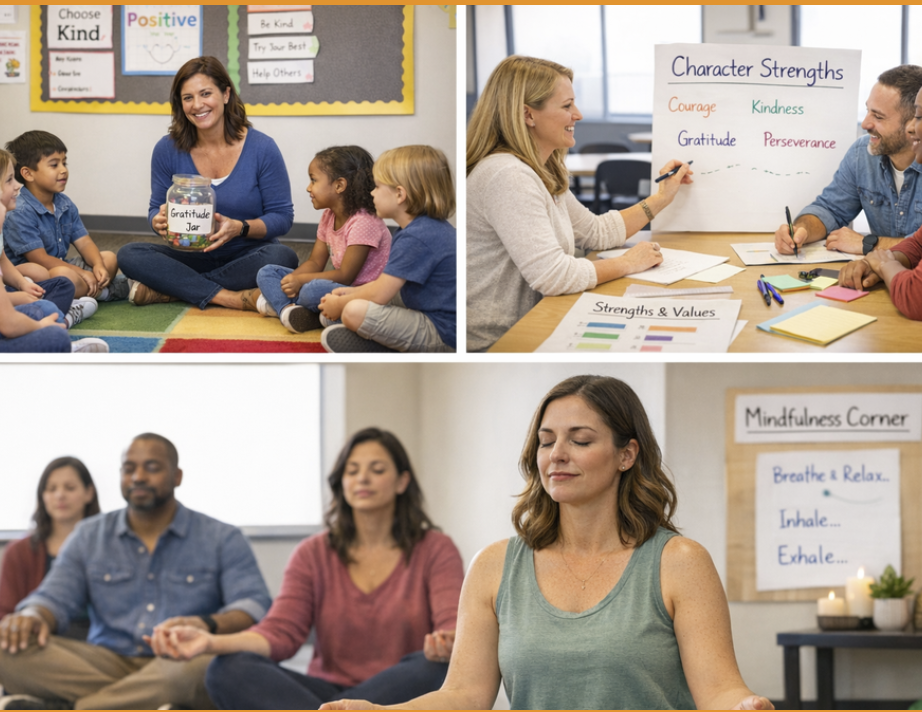
What Participants Learn
- Understand the foundations of positive psychology and positive education, and how they can be applied in schools and learning environments.
- Use practical strategies to support emotional resilience, motivation, engagement and student wellbeing.
- Design activities and learning experiences that promote character strengths, positive relationships and life-skills development.
- Integrate mindfulness practices into daily teaching to improve focus, emotional regulation and self-awareness.
- Create classroom routines and approaches that strengthen belonging, safety and positive behaviour.
- Reflect on their own wellbeing and teaching habits so they can model emotional intelligence and balance for students.
- Develop practical ideas for school programmes that combine academic progress with personal and social development.
How the Course Works
- Interactive workshops where participants explore positive education through discussion, practice and shared experience.
- Mindfulness exercises that help participants develop self-awareness, emotional regulation and stress-management strategies.
- Collaborative design tasks where educators create activities and small projects for use in their own classrooms and institutions.
- Self-reflection exercises that support personal growth and deeper understanding of wellbeing in education.
- Peer learning and group exchange that allow participants to learn from different school systems, cultures and experiences.
- Practical application throughout the course so that ideas are translated into real classroom routines, strategies and programme concepts.
-
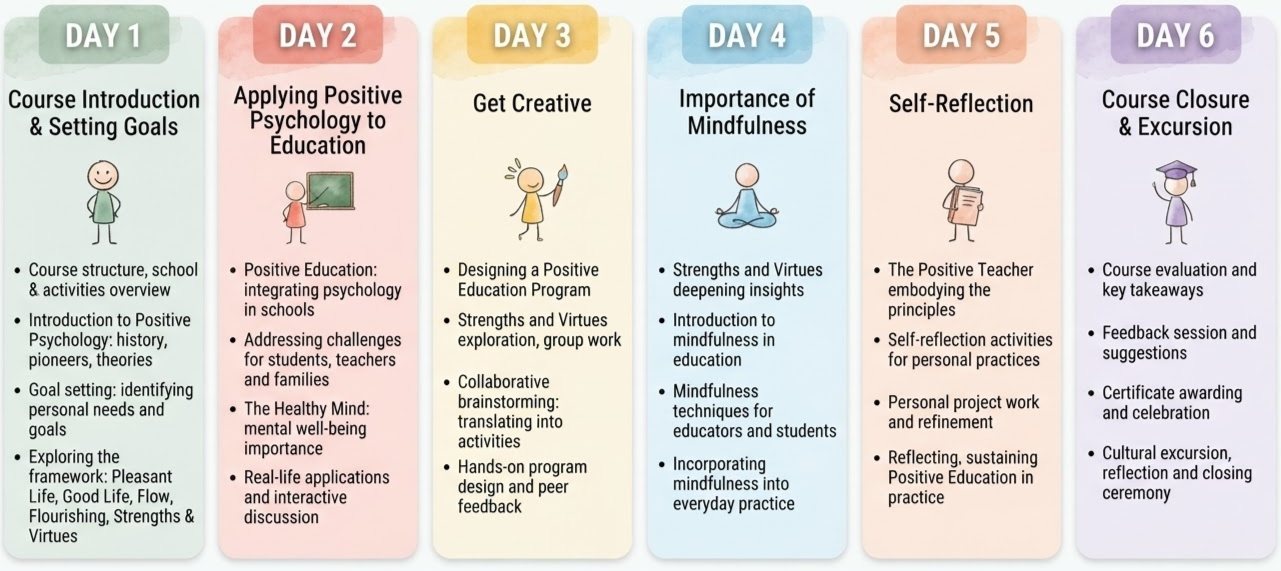
9:00–9:30 Overview of the Course Structure, the School, and the Week’s Activities
9:30–10:00 Introduction to Positive Psychology: History, Key Pioneers, Theories, and Methods
10:00–10:15 Coffee Break
10:15–11:00 Goal Setting: Identifying Personal Needs and Goals for Participants and Their Students
11:00–12:00 Participant Presentations: Sharing Information About Their Schools
12:00–13:00 Exploring the Framework of Positive Psychology: Pleasant Life, Good Life, Flow, Flourishing, Strengths & Virtues
13:00–14:00 Wrap-Up: Aligning Goals and Expectations -
9:00–9:30 Introduction to Positive Education: Integrating Positive Psychology into Educational Settings
9:30–10:00 Application of Positive Psychology: Addressing Challenges Faced by Students, Teachers, and Families
10:00–10:15 Coffee Break
10:15–11:00 The Healthy Mind: Understanding the Importance of Mental Well-Being
11:00–12:00 Experience Sharing: Discussing Challenges in Education and Solutions Through Positive Psychology
12:00–13:00 Interactive Discussion: Real-Life Applications of Positive Psychology in Schools
13:00–14:00 Reflection and Q&A -
9:00–9:30 Designing a Positive Education Program: Exploring Core Concepts
9:30–10:00 Strengths and Virtues Exploration, Part 1 (Group Work)
10:00–10:15 Coffee Break
10:15–11:00 Collaborative Brainstorming: Translating Strengths and Virtues into Educational Activities
11:00–12:00 Hands-On Program Design: Initial Framework Development
12:00–13:00 Refinement and Feedback: Peer Review of Program Designs
13:00–14:00 Wrap-Up: Identifying Key Elements for Success -
9:00–9:30 Strengths and Virtues Exploration, Part 2: Deepening Insights
9:30–10:00 Introduction to Mindfulness in Education: Benefits for Students and Teachers
10:00–10:15 Coffee Break
10:15–11:00 Hands-On Project Work: Designing Personalized Positive Education Programs
11:00–12:00 Mindfulness Techniques for Educators and Students: Practical Applications
12:00–13:00 Developing Mindfulness Components Within Positive Education Programs
13:00–14:00 Reflection: Incorporating Mindfulness Into Everyday Educational Practice
-
9:00–9:30 The Positive Teacher: Embodying the Principles of Positive Psychology
9:30–10:00 Self-Reflection Activities: Enhancing Personal Practices for Positive Education
10:00–10:15 Coffee Break
10:15–11:00 Personal Project Work: Refining and Developing Positive Education Projects
11:00–12:00 Interactive Feedback Session: Sharing Personal Project Progress
12:00–13:00 Reflection and Next Steps: Sustaining Positive Education in Practice
13:00–14:00 Closing Discussion: Lessons Learned and Future Plans -
9:00–9:30 Course Evaluation: Review of Acquired Competencies and Key Takeaways
9:30–10:00 Feedback Session: Participant Insights and Suggestions for Future Improvement
10:00–10:15 Coffee Break
10:15–11:00 Certificate of Attendance: Awarding and Celebrating Achievements
11:00–12:00 Excursion: Cultural Activities to Enhance Learning and Reflection
12:00–13:00 Reflective Discussion: Connecting Cultural Experiences to Positive Psychology
13:00–14:00 Closing Ceremony and Final Reflections
What Participants Take Back
- A stronger understanding of how positive education can improve both student wellbeing and academic engagement.
- Practical strategies to create supportive, inclusive and emotionally safe classroom environments.
- Activities and routines that help students develop resilience, self-awareness, positive relationships and life skills.
- Mindfulness-based tools that can be integrated into daily teaching to improve focus, calm and emotional regulation.
- Greater confidence in modelling emotional intelligence, reflective practice and balanced teaching approaches.
- Ideas for school and classroom initiatives that connect academic learning with wellbeing, character strengths and flourishing.
- A more holistic view of education that supports both performance and long-term personal development.
Course Format
- Duration: one-week course (5-6 training days). Alternative formats may be available on request.
- Daily workload: 5-6 hours per day, from 09:00 to 14:00, with one coffee break and several short transitions between activities.
- Language: English.
- Language requirement: participants should have at least an A2/B1 level of English to actively follow the training and take part in discussions and practical work.
- Digital level: no specific digital skills are required. This course focuses on dialogue, group work, and activity-based methods rather than digital tools.
- Equipment: participants are not required to bring laptops or tablets. Materials needed for activities (paper, markers, cards, etc.) are provided
- Target groups: teachers, trainers, youth workers, adult educators, school leaders, and other education professionals.
- Adaptation: examples and activities are adapted to participants’ areas of work, age groups and institutional contexts whenever possible.
- Funding fit: this course is designed to align with Erasmus+ KA1 staff mobility funding for SCH, ADU and VET participants, according to their approved budget and funding rules.
Course Fee
€80 per participant, per training day
This course fee is designed to align with Erasmus+ KA1 staff mobility funding for eligible SCH, ADU and VET participants.
What is Included:
✔Erasmus+ Fundable: eligible for KA1 grants
✔Flexibility Guaranteed: easy changes with minimal restrictions
✔Full experience: coffee breaks to cultural visits
✔ Certificate of attendance: 5 hours per day, 30h total
Post-Course Training: 80€ voucher on 18+ courses
Travel and Stay Support
We support participants with practical guidance before arrival so they can organise their mobility with more confidence.
We suggest:
✔Accommodation options such as hotels and apartments,
✔Local transportation information, and, airport transfer options,
✔ Half-day and full-day trip ideas, cultural activities and useful local recommendations.
These services are not directly provided by Colony of Creators unless explicitly confirmed in advance, but we do help participants identify the most suitable options for their stay and make the most of their Erasmus+ experience.
100% funded by the Erasmus Plus Program through your Erasmus+ SCH, ADU or VET grant.
Eligible institutions may use Erasmus+ KA1 mobility funding to cover course-related costs according to their approved budget and funding rules.
Request Information About This Erasmus+Course
If you are a teacher, trainer, school leader or Erasmus+ coordinator interested in Smart Teaching: AI-Driven Solutions with ChatGPT and Beyond, use this form to request course details, dates, group options or support for Erasmus+ planning.