Outdoor Learning: A Sustainable Approach
Schools are under growing pressure to address sustainability, environmental awareness and student disengagement at the same time. Traditional classroom approaches alone often struggle to make environmental issues feel real, relevant and actionable for learners.
Outdoor learning and Education for Sustainable Development (ESD) offer a practical way to change this. When educators bring lessons into nature and local environments, they can connect theory with lived experience, increase motivation and help students see themselves as active contributors to sustainability.
This course helps educators design outdoor learning experiences that are both curriculum-linked and responsive to local environmental challenges. Participants leave with concrete tools and strategies to make sustainability education more hands-on, inclusive and inspiring.
Why This Course Matters
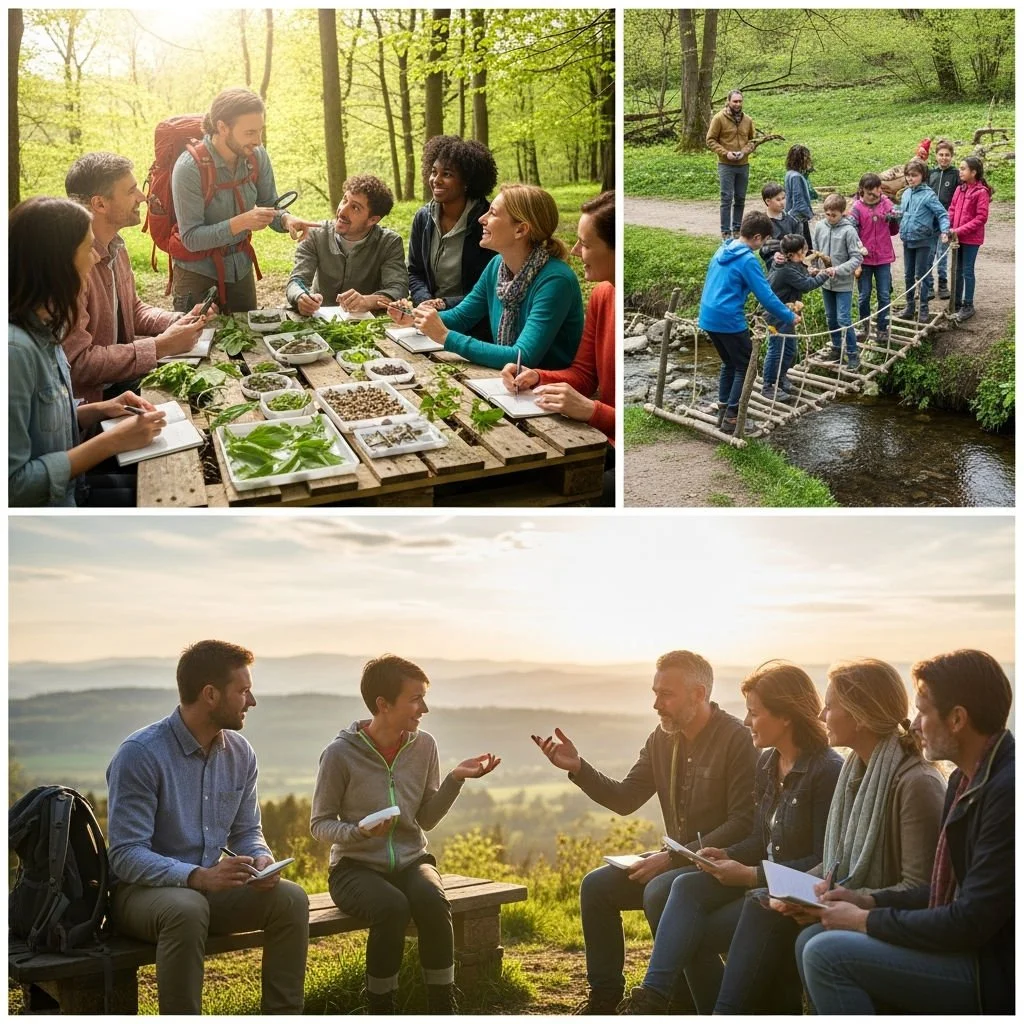
What Participants Learn
- Understand and apply key principles of Education for Sustainable Development (ESD) in formal and non-formal educational settings.
- Design and implement outdoor education activities that align with EU curriculum standards and respond to local environmental realities.
- Develop creative strategies that engage students in environmental learning and help combat disengagement.
- Foster intercultural collaboration around outdoor education and share best practices across European countries.
- Use nature-based activities and reflective exercises to strengthen personal and social skills such as teamwork, communication and responsibility.
- Create personalised action plans to integrate outdoor learning and ESD into school programmes and community initiatives.
How the Course Works
-This course combines practical, outdoor-based learning with interactive and collaborative approaches. Participants learn through:
- Hands-on outdoor training sessions in natural and local settings.
- Cooperative group work and idea-sharing activities that connect different European perspectives.
- Role-playing and scenario-based exercises that address real environmental and sustainability challenges.
- Reflective journaling and feedback sessions to consolidate learning and support personal growth.
- Co-creation workshops where participants design environmental education tools, activities and strategies.
- Intercultural exchanges that highlight diverse approaches to outdoor learning and ESD.
-
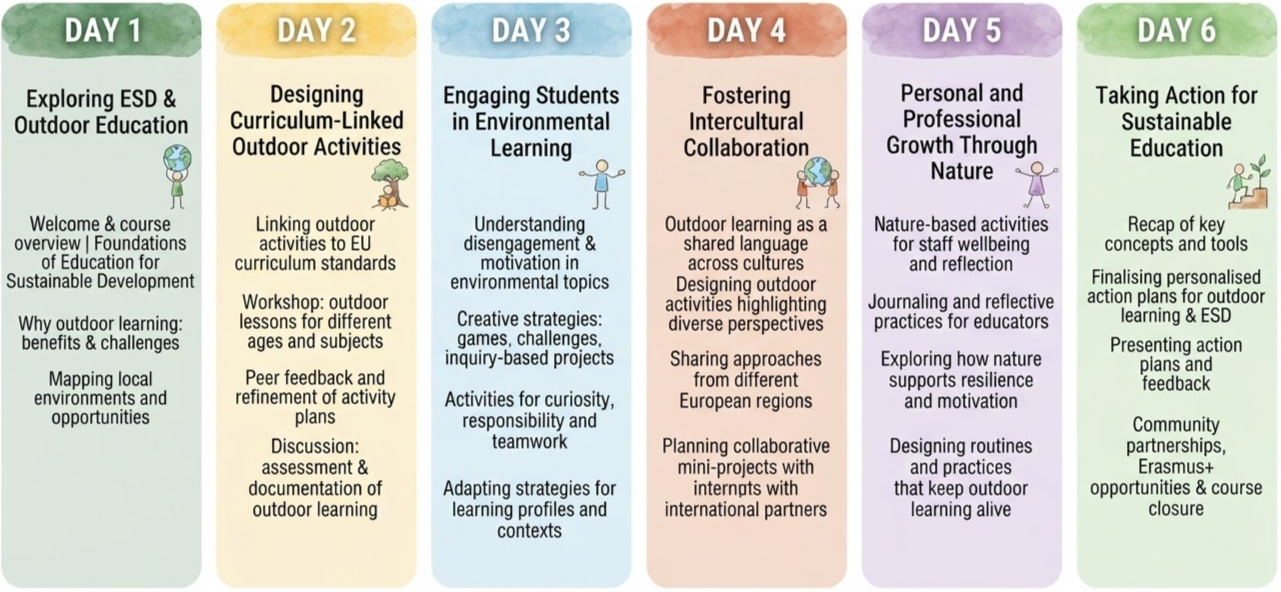
09:00–09:30 | Welcome, course overview and introductions
09:30–10:15 | Foundations of Education for Sustainable Development (ESD)
10:15–10:30 | Coffee break
10:30–11:30 | Why outdoor learning? Benefits and challenges
11:30–12:30 | Mapping local environments and opportunities for outdoor education
12:30–13:30 | Reflection: participants’ contexts and first ideas
-
09:00–09:30 | Recap and warm-up activity outdoors
09:30–10:15 | Linking outdoor activities to EU curriculum standards and subject goals
10:15–10:30 | Coffee break
10:30–11:30 | Workshop: designing outdoor lessons for different age groups and subjects
11:30–12:30 | Peer feedback and refinement of activity plans
12:30–13:30 | Discussion: assessment and documentation of outdoor learning
-
09:00–09:30 | Recap and energiser
09:30–10:15 | Understanding student disengagement and motivation in environmental topics
10:15–10:30 | Coffee break
10:30–11:30 | Creative strategies: games, challenges and inquiry-based outdoor projects
11:30–12:30 | Practising activities that encourage curiosity, responsibility and teamwork
12:30–13:30 | Debrief: how to adapt strategies for different learning profiles and contexts
-
09:00–09:30 | Recap and intercultural warm-up
09:30–10:15 | Outdoor learning as a shared language across cultures
10:15–10:30 | Coffee break
10:30–11:30 | Group work: designing outdoor activities that highlight diverse perspectives and local realities
11:30–12:30 | Sharing and comparing approaches from different European regions
12:30–13:30 | Planning collaborative activities or mini-projects with international partners
-
09:00–09:30 | Recap and reflective outdoor exercise
09:30–10:15 | Nature-based activities for staff wellbeing and professional reflection
10:15–10:30 | Coffee break
10:30–11:30 | Journaling and reflective practices for educators in outdoor settings
11:30–12:30 | Exploring how time in nature supports resilience and long-term motivation
12:30–13:30 | Designing personal routines and school practices that keep outdoor learning alive
-
09:00–09:30 | Recap of key concepts and tools
09:30–10:15 | Finalising personalised action plans for outdoor learning and ESD
10:15–10:30 | Coffee break
10:30–11:30 | Presenting action plans; peer and facilitator feedback
11:30–12:30 | Identifying opportunities for community partnerships and Erasmus+ projects
12:30–13:30 | Course reflection, evaluation and closure
What Participants Take Back
- A deeper understanding of ESD and its role in modern education.
- Practical skills to design and implement effective outdoor learning activities linked to curriculum goals.
- Innovative strategies to address local environmental challenges through student projects and school initiatives.
- Stronger ability to collaborate across cultures and educational systems on sustainability and outdoor learning.
- Motivation and confidence to lead sustainable education initiatives in their schools and communities.
- The capacity to turn environmental challenges into engaging learning opportunities that build responsibility and social skills.
Course Format
- Duration: one-week course (5-6 training days). Alternative formats may be available on request.
- Daily workload: 5-6 hours per day, from 09:00 to 14:00, with one coffee break and several short transitions between activities.
- Language: English.
- Language requirement: participants should have at least an A2/B1 level of English to actively follow the training and take part in discussions and practical work.
- Digital level: no specific digital skills are required. This course focuses on dialogue, group work, and activity-based methods rather than digital tools.
- Equipment: participants are not required to bring laptops or tablets. Materials needed for activities (paper, markers, cards, etc.) are provided
- Target groups: teachers, trainers, youth workers, adult educators, school leaders, and other education professionals.
- Adaptation: examples and activities are adapted to participants’ areas of work, age groups and institutional contexts whenever possible.
- Funding fit: this course is designed to align with Erasmus+ KA1 staff mobility funding for SCH, ADU and VET participants, according to their approved budget and funding rules.
Course Fee
€80 per participant, per training day
This course fee is designed to align with Erasmus+ KA1 staff mobility funding for eligible SCH, ADU and VET participants.
What is Included:
✔Erasmus+ Fundable: eligible for KA1 grants
✔Flexibility Guaranteed: easy changes with minimal restrictions
✔Full experience: coffee breaks to cultural visits
✔ Certificate of attendance: 5 hours per day, 30h total
Post-Course Training: 80€ voucher on 18+ courses
Travel and Stay Support
We support participants with practical guidance before arrival so they can organise their mobility with more confidence.
We suggest:
✔Accommodation options such as hotels and apartments,
✔Local transportation information, and, airport transfer options,
✔ Half-day and full-day trip ideas, cultural activities and useful local recommendations.
These services are not directly provided by Colony of Creators unless explicitly confirmed in advance, but we do help participants identify the most suitable options for their stay and make the most of their Erasmus+ experience.
100% funded by the Erasmus Plus Program through your Erasmus+ SCH, ADU or VET grant.
Eligible institutions may use Erasmus+ KA1 mobility funding to cover course-related costs according to their approved budget and funding rules.
Request Information About This Erasmus+ Course
If you are a teacher, trainer, school leader or Erasmus+ coordinator interested in Smart Teaching: AI-Driven Solutions with ChatGPT and Beyond, use this form to request course details, dates, group options or support for Erasmus+ planning.