Nature as Your Classroom: Outdoor Education
Many schools face disengaged students, crowded classrooms and limited time for hands-on learning. At the same time, European education policy increasingly calls for sustainability, environmental literacy and practical experience aligned with the European Green Deal and EU Biodiversity Strategy 2030.
Outdoor education connects these priorities. It gives educators a way to use nature and local environments to increase curiosity, motivation and resilience while still meeting subject standards. When teachers know how to design outdoor learning experiences, they can turn ordinary spaces into powerful classrooms.
This course gives educators clear, practical tools to integrate outdoor education into their teaching. Participants learn how to design EU-aligned lessons outdoors, use adventure pedagogy to build teamwork and problem-solving, and create “green classrooms” that support both academic progress and wellbeing.
Why This Course Matters
What Participants Learn
- Design outdoor curricula aligned with EU priorities and core subject standards (STEM, humanities and cross-curricular themes).
- Lead group activities that build teamwork, leadership, communication and problem-solving in natural and urban environments.
- Integrate sustainability education with the European Sustainability Competence Framework in practical, age-appropriate ways.
- Adapt parks, schoolyards and urban spaces for nature-based learning, even in low-resource schools.
- Create “green classrooms” and nature-based routines that improve attendance, motivation and engagement.
- Develop ideas for Erasmus+ partnerships and cross-border ecological projects such as school gardens, climate action clubs and local biodiversity initiatives.
How the Course Works
-Aligned with the EU’s Pathways to School Success initiative, this course combines:
- Experiential learning: forest school principles, simple survival skills workshops and ecological reflection sessions.
- Peer-to-peer design: co-creating outdoor lesson plans and projects with educators from different European regions.
- Adventure pedagogy: orienteering, nature journaling and urban scavenger hunts that model active, student-centred learning.
- Ecological literacy: exploring case studies such as forest kindergarten models and other nature-based education approaches.
- Holistic reflection: daily debriefs linking outdoor activities to formal curriculum goals and assessment frameworks.
-
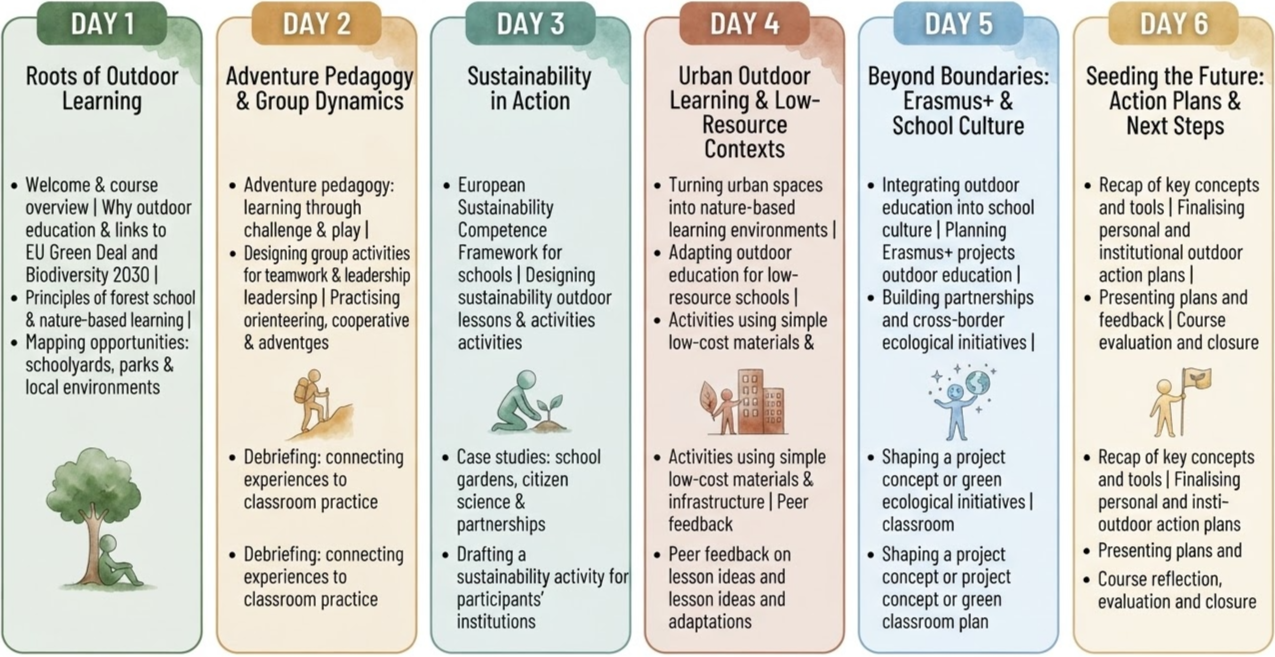
09:00–09:30 | Welcome, course overview and introductions
09:30–10:15 | Why outdoor education? Links to European Green Deal and EU Biodiversity Strategy 2030
10:15–10:30 | Coffee break
10:30–11:30 | Principles of forest school and nature-based learning
11:30–12:30 | Mapping opportunities: schoolyards, parks and local environments as classrooms
12:30–13:30 | Reflection and group sharing: participants’ contexts and first ideas
-
09:00–09:30 | Recap and energiser outdoors
09:30–10:15 | Adventure pedagogy: learning through challenge, exploration and play
10:15–10:30 | Coffee break
10:30–11:30 | Designing group activities that build teamwork, leadership and communication
11:30–12:30 | Practising orienteering, cooperative tasks and simple adventure challenges
12:30–13:30 | Debrief: connecting experiences to classroom practice and student behaviour
-
09:00–09:30 | Recap and nature-based warm-up
09:30–10:15 | European Sustainability Competence Framework: key ideas for schools
10:15–10:30 | Coffee break
10:30–11:30 | Designing sustainability-focused outdoor lessons (biodiversity, climate, local environment)
11:30–12:30 | Case studies: school gardens, citizen science projects and community partnerships
12:30–13:30 | Group work: drafting a sustainability activity or mini-project for participants’ institutions
-
09:00–09:30 | Recap and urban environment walk
09:30–10:15 | Turning urban spaces into nature-based learning environments
10:15–10:30 | Coffee break
10:30–11:30 | Adapting outdoor education for low-resource schools and diverse age groups
11:30–12:30 | Designing activities that use simple, low-cost materials and existing infrastructure
12:30–13:30 | Peer feedback on lesson ideas and adaptations
-
09:00–09:30 | Recap and outdoor energiser
09:30–10:15 | Integrating outdoor education into school culture and long-term planning
10:15–10:30 | Coffee break
10:30–11:30 | Planning Erasmus+ projects around outdoor education, school gardens or climate action clubs
11:30–12:30 | Building partnerships and cross-border ecological initiatives
12:30–13:30 | Group work: shaping a project concept or “green classroom” plan
-
09:00–09:30 | Recap of key concepts and tools
09:30–10:15 | Finalising personal and institutional outdoor action plans
10:15–10:30 | Coffee break
10:30–11:30 | Presenting plans; peer and facilitator feedback
11:30–12:30 | Identifying local and European collaboration opportunities
12:30–13:30 | Course reflection, evaluation and closure
What Participants Take Back
- A personalised Outdoor Action Plan ready to implement in their school or organisation.
- At least 10 practical nature-based activities that can boost student attendance, motivation and engagement.
- Strategies to lead EU-funded projects such as school gardens, climate action clubs or local biodiversity initiatives.
- Skills to assess social-emotional growth and teamwork in outdoor settings, not just academic outcomes.
- Confidence to advocate for green infrastructure and outdoor learning spaces in school policy discussions.
- A clearer vision of how outdoor education can support sustainability goals, wellbeing and academic learning together.
Course Format
- Duration: one-week course (5-6 training days). Alternative formats may be available on request.
- Daily workload: 5-6 hours per day, from 09:00 to 14:00, with one coffee break and several short transitions between activities.
- Language: English.
- Language requirement: participants should have at least an A2/B1 level of English to actively follow the training and take part in discussions and practical work.
- Digital level: no specific digital skills are required. This course focuses on dialogue, group work, and activity-based methods rather than digital tools.
- Equipment: participants are not required to bring laptops or tablets. Materials needed for activities (paper, markers, cards, etc.) are provided
- Target groups: teachers, trainers, youth workers, adult educators, school leaders, and other education professionals.
- Adaptation: examples and activities are adapted to participants’ areas of work, age groups and institutional contexts whenever possible.
- Funding fit: this course is designed to align with Erasmus+ KA1 staff mobility funding for SCH, ADU and VET participants, according to their approved budget and funding rules.
Course Fee
€80 per participant, per training day
This course fee is designed to align with Erasmus+ KA1 staff mobility funding for eligible SCH, ADU and VET participants.
What is Included:
✔Erasmus+ Fundable: eligible for KA1 grants
✔Flexibility Guaranteed: easy changes with minimal restrictions
✔Full experience: coffee breaks to cultural visits
✔ Certificate of attendance: 5 hours per day, 30h total
Post-Course Training: 80€ voucher on 18+ courses
Travel and Stay Support
We support participants with practical guidance before arrival so they can organise their mobility with more confidence.
We suggest:
✔Accommodation options such as hotels and apartments,
✔Local transportation information, and, airport transfer options,
✔ Half-day and full-day trip ideas, cultural activities and useful local recommendations.
These services are not directly provided by Colony of Creators unless explicitly confirmed in advance, but we do help participants identify the most suitable options for their stay and make the most of their Erasmus+ experience.
100% funded by the Erasmus Plus Program through your Erasmus+ SCH, ADU or VET grant.
Eligible institutions may use Erasmus+ KA1 mobility funding to cover course-related costs according to their approved budget and funding rules.
Request Information About This Erasmus+ Course
If you are a teacher, trainer, school leader or Erasmus+ coordinator interested in Smart Teaching: AI-Driven Solutions with ChatGPT and Beyond, use this form to request course details, dates, group options or support for Erasmus+ planning.