Coaching Strategies for Educators
Educators are expected to support learners, families and colleagues while navigating constant change, pressure and complex needs. Many feel overwhelmed, under-supported or unsure how to coach themselves and others through challenges in a sustainable way.
This course is designed for teachers, trainers, school leaders, counsellors, youth workers and adult educators who want to use coaching strategies to strengthen professional resilience, reflective practice and staff wellbeing. It focuses on helping educators shift from reactive problem-solving to proactive, growth-oriented coaching in their daily work.
Participants learn how to use simple coaching tools, trauma-informed perspectives and AI-enhanced storytelling to support colleagues and learners, design more supportive learning environments and communicate more effectively across different roles and cultures.
Why This Course Matters
What Participants Learn
- Understand key coaching principles for educators, including active listening, powerful questioning, goal-setting and accountability.
- Recognise how personal experience, stress and trauma can influence interactions with learners and colleagues, and use trauma-informed perspectives to respond more constructively.
- Design coaching conversations and support plans that strengthen professional resilience, mental health and self-awareness for staff and educators.
- Use GPTs and Gemini to generate coaching questions, reflection prompts, scenario ideas and simple coaching frameworks.
- Use Canva AI to create accessible visual coaching tools, handouts and reflection journals for staff and teams.
- Use Kling and Veo to produce short, illustrative video stories and examples for training sessions.
- Use ElevenLabs and Suno to create audio stories, guided reflections and simple soundscapes that support coaching and wellbeing activities.
- Use Minvo to turn longer video or recorded sessions into short, focused clips for micro-learning and follow-up coaching.
- Apply non-formal education and storytelling techniques (including simple narrative frameworks inspired by Pixar) to make complex ideas easier to understand and act on.
- Develop practical evaluation tools to measure the impact of coaching interventions and professional development activities.
- Build cross-cultural and cross-role collaboration skills so educators can support one another more effectively in diverse Erasmus+ contexts.
How the Course Works
- Learner-centred approach: participants work through real coaching scenarios from their own educational contexts.
- Interactive input: short, focused sessions introduce coaching models, trauma-informed frameworks and storytelling techniques.
- Workshops: practical activities guide participants in designing coaching conversations, using GPTs, Gemini and creative tools to support reflection, and creating simple resources for staff.
- Peer-to-peer learning: collaboration and feedback circles allow educators from different countries and roles to share perspectives and refine strategies.
- Real-life application: participants design tangible coaching plans, micro-interventions and content they can take back to their schools and organisations.
- Expert feedback: facilitators provide constructive input on participants’ coaching plans and materials, building confidence in applying new strategies.
-
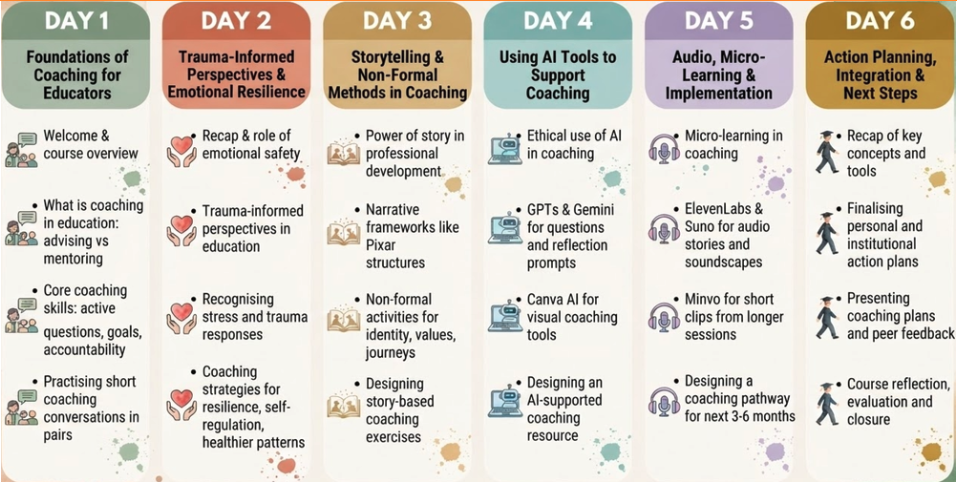
09:00–09:30 | Welcome, course overview and introductions
09:30–10:15 | What is coaching in education? Differences between advising, mentoring and coaching
10:15–10:30 | Coffee break
10:30–11:30 | Core coaching skills: active listening, powerful questions, goal-setting and accountability
11:30–12:30 | Practising short coaching conversations in pairs using real school scenarios
12:30–13:30 | Reflection on participants’ contexts and first areas where coaching could make a difference
-
09:00–09:30 | Recap and the role of emotional safety in coaching
09:30–10:15 | Basics of trauma-informed perspectives in educational settings
10:15–10:30 | Coffee break
10:30–11:30 | Recognising stress and trauma responses in educators and learners
11:30–12:30 | Coaching strategies to support resilience, self-regulation and healthier patterns
12:30–13:30 | Small-group work to design supportive coaching responses for challenging situations
-
09:00–09:30 | Recap and the power of story in professional development
09:30–10:15 | Simple narrative frameworks (including Pixar-inspired structures) for coaching and training
10:15–10:30 | Coffee break
10:30–11:30 | Non-formal activities to explore identity, values and professional journeys
11:30–12:30 | Designing story-based coaching exercises for staff meetings, peer support and mentoring
12:30–13:30 | Sharing and feedback on story-based activities
-
09:00–09:30 | Recap and ethical use of AI in coaching and staff support
09:30–10:15 | Using GPTs and Gemini to generate coaching questions, reflection prompts and scenario ideas
10:15–10:30 | Coffee break
10:30–11:30 | Using Canva AI to create simple visual coaching tools, handouts and reflection journals
11:30–12:30 | Using Kling and Veo to produce short, illustrative video stories for staff training and reflection
12:30–13:30 | Group work: designing a small AI-supported coaching resource for a real educational context
-
09:00–09:30 | Recap and micro-learning in coaching and professional development
09:30–10:15 | Using ElevenLabs and Suno to create audio stories, guided reflections and soundscapes for staff wellbeing
10:15–10:30 | Coffee break
10:30–11:30 | Using Minvo to turn longer recordings or training sessions into short clips for follow-up coaching
11:30–12:30 | Planning how to integrate these audio and video resources into staff meetings, mentoring and PD days
12:30–13:30 | Designing a coaching pathway for the next 3–6 months in participants’ institutions
-
09:00–09:30 | Recap of key concepts: coaching skills, trauma-informed perspectives, storytelling, AI tools and implementation
09:30–10:15 | Finalising personal and institutional action plans
10:15–10:30 | Coffee break
10:30–11:30 | Presenting coaching plans and resources; peer feedback and improvement
11:30–12:30 | Identifying support networks and collaboration opportunities after the course
12:30–13:30 | Course reflection, evaluation and closure
What Participants Take Back
- A set of ready-to-use coaching tools and conversation structures for use with colleagues, teams and learners.
- Greater awareness of how stress and trauma can affect behaviour, and practical ways to respond with empathy and clear boundaries.
- Concrete strategies to support staff resilience, reflective practice and wellbeing in schools and learning centres.
- Experience using GPTs, Gemini, Canva AI, Kling, Veo, ElevenLabs, Suno and Minvo to create coaching prompts, visual stories, audio reflections and short training clips.
- Confidence in using storytelling and non-formal methods to communicate ideas and foster change without overwhelming colleagues.
- Practical evaluation templates to track the impact of coaching interventions and professional development over time.
- Stronger ability to collaborate across roles and cultures, drawing on shared coaching language and methods.
Course Format
- Duration: one-week course (5-6 training days). Alternative formats may be available on request.
- Daily workload: 5-6 hours per day, from 09:00 to 14:00, with one coffee break and several short transitions between activities.
- Language: English.
- Language requirement: participants should have at least an A2/B1 level of English to actively follow the training and take part in discussions and practical work.
- Digital level: no specific digital skills are required. This course focuses on dialogue, group work, and activity-based methods rather than digital tools.
- Equipment: participants are not required to bring laptops or tablets. Materials needed for activities (paper, markers, cards, etc.) are provided
- Target groups: teachers, trainers, youth workers, adult educators, school leaders, and other education professionals.
- Adaptation: examples and activities are adapted to participants’ areas of work, age groups and institutional contexts whenever possible.
- Funding fit: this course is designed to align with Erasmus+ KA1 staff mobility funding for SCH, ADU and VET participants, according to their approved budget and funding rules.
Course Fee
€80 per participant, per training day
This course fee is designed to align with Erasmus+ KA1 staff mobility funding for eligible SCH, ADU and VET participants.
What is Included:
✔Erasmus+ Fundable: eligible for KA1 grants
✔Flexibility Guaranteed: easy changes with minimal restrictions
✔Full experience: coffee breaks to cultural visits
✔ Certificate of attendance: 5 hours per day, 30h total
Post-Course Training: 80€ voucher on 18+ courses
Travel and Stay Support
We support participants with practical guidance before arrival so they can organise their mobility with more confidence.
We suggest:
✔Accommodation options such as hotels and apartments,
✔Local transportation information, and, airport transfer options,
✔ Half-day and full-day trip ideas, cultural activities and useful local recommendations.
These services are not directly provided by Colony of Creators unless explicitly confirmed in advance, but we do help participants identify the most suitable options for their stay and make the most of their Erasmus+ experience.
100% funded by the Erasmus Plus Program through your Erasmus+ SCH, ADU or VET grant.
Eligible institutions may use Erasmus+ KA1 mobility funding to cover course-related costs according to their approved budget and funding rules.
Request Information About This Erasmus+ Course
If you are a teacher, trainer, school leader or Erasmus+ coordinator interested in Smart Teaching: AI-Driven Solutions with ChatGPT and Beyond, use this form to request course details, dates, group options or support for Erasmus+ planning.