Creative Outdoor Arts for Sustainability Education
Many schools run sustainability activities, but teachers report that students often see them as one-off events rather than meaningful learning experiences. Time, space and resource constraints make it hard to integrate sustainability into everyday teaching in a way that truly changes attitudes and behaviour.
Creative outdoor arts offer a powerful way to shift this. When students create visual stories, installations and performances in nature, sustainability stops being just information and becomes something they co-create and remember. It connects emotions, creativity and environmental responsibility.
This course equips educators with practical tools to use outdoor arts as a bridge between sustainability goals and concrete student action. Participants learn how to design engaging projects that align with curriculum standards, strengthen social skills and help students see themselves as active contributors to the green transition.
Why This Course Matters
What Participants Learn
- Understand how Education for Sustainable Development (ESD) and creative arts can work together in formal and non-formal education.
- Design and implement outdoor art activities that align with EU curriculum standards and local environmental themes.
- Develop creative strategies to engage students who feel disconnected from sustainability topics or traditional lessons.
- Use nature-based arts, storytelling and visual projects to help students explore climate, biodiversity and community issues.
- Foster intercultural collaboration by sharing and co-creating art projects with educators from different European countries.
- Cultivate personal and social skills such as communication, teamwork and empathy through collaborative outdoor arts.
- Create personalised action plans to integrate creative outdoor arts into school programmes and community initiatives.
How the Course Works
-This course combines outdoor-based learning with creative arts and collaborative practice. Participants learn through:
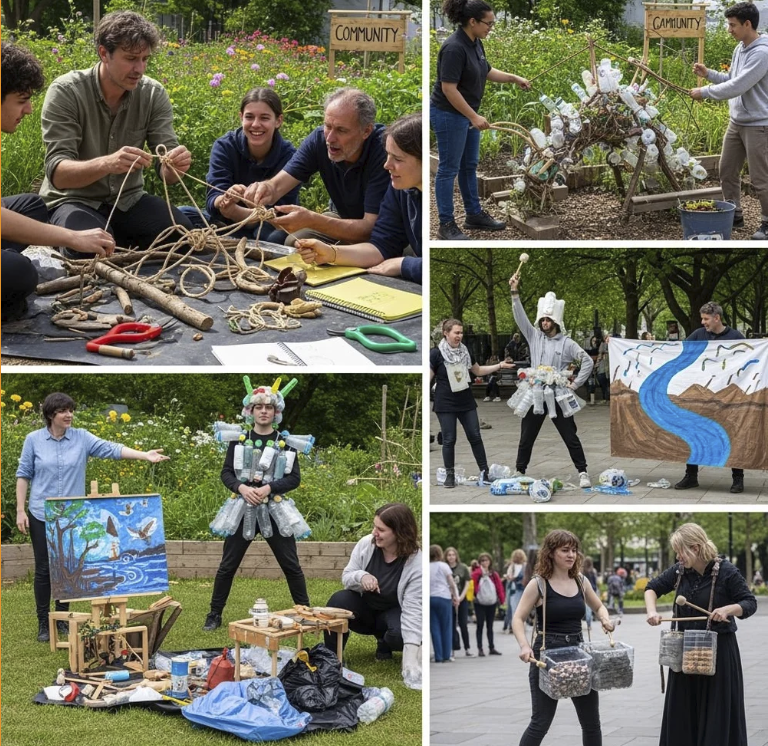
- Hands-on outdoor art sessions in natural and local environments.
- Cooperative group work where educators design and test creative activities together.
- Role-playing and scenario-based exercises to explore environmental and social challenges through art.
- Reflective journaling and group feedback to deepen learning and refine project ideas.
- Workshops focused on co-creating environmental education tools, art projects and storytelling formats.
- Intercultural exchanges to showcase diverse approaches to using arts for sustainability across Europe.
-
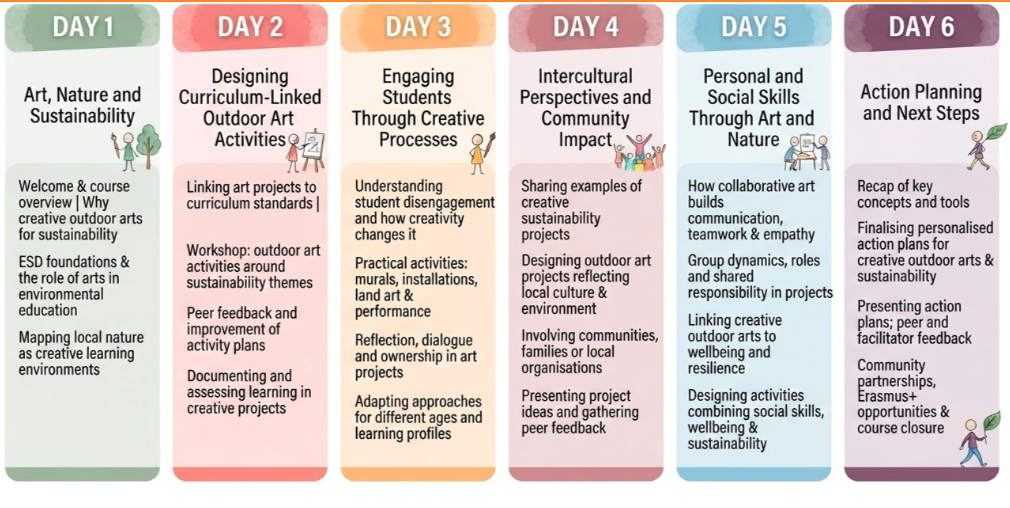
09:00–09:30 | Welcome, course overview and introductions
09:30–10:15 | Why creative outdoor arts for sustainability? Benefits for students and schools
10:15–10:30 | Coffee break
10:30–11:30 | Exploring ESD foundations and the role of arts in environmental education
11:30–12:30 | Mapping local nature and spaces as creative learning environments
12:30–13:30 | Reflection and sharing: participants’ contexts and first ideas
-
09:00–09:30 | Recap and outdoor warm-up
09:30–10:15 | Linking art projects to curriculum standards and subject goals
10:15–10:30 | Coffee break
10:30–11:30 | Workshop: designing outdoor art activities around sustainability themes
11:30–12:30 | Peer feedback and improvement of activity plans
12:30–13:30 | Discussion: documenting and assessing learning in creative projects
-
09:00–09:30 | Recap and energiser
09:30–10:15 | Understanding student disengagement and how creative work can change it
10:15–10:30 | Coffee break
10:30–11:30 | Practical activities: collaborative murals, installations, land art and performance
11:30–12:30 | Techniques for encouraging reflection, dialogue and ownership in art projects
12:30–13:30 | Debrief: adapting approaches for different ages and learning profiles
-
09:00–09:30 | Recap and intercultural warm-up
09:30–10:15 | Sharing examples of creative sustainability projects from different countries
10:15–10:30 | Coffee break
10:30–11:30 | Group work: designing outdoor art projects that reflect local culture and environment
11:30–12:30 | Planning how to involve communities, families or local organisations
12:30–13:30 | Presenting project ideas and gathering feedback from peers
-
09:00–09:30 | Recap and reflective outdoor exercise
09:30–10:15 | How collaborative art builds communication, teamwork and empathy
10:15–10:30 | Coffee break
10:30–11:30 | Activities focused on group dynamics, roles and shared responsibility in projects
11:30–12:30 | Linking creative outdoor arts to wellbeing and resilience for students and staff
12:30–13:30 | Designing activities that combine social skills, wellbeing and sustainability themes
-
09:00–09:30 | Recap of key concepts and tools
09:30–10:15 | Finalising personalised action plans for creative outdoor arts and sustainability
10:15–10:30 | Coffee break
10:30–11:30 | Presenting action plans and project concepts; peer and facilitator feedback
11:30–12:30 | Identifying opportunities for community partnerships and Erasmus+ projects
12:30–13:30 | Course reflection, evaluation and closure
What Participants Take Back
- Clear understanding of how creative outdoor arts can strengthen sustainability education in different contexts.
- A collection of ready-to-use art-based activities and project ideas for nature-based learning.
- Practical skills to design, facilitate and assess creative sustainability projects with diverse groups of learners.
- Confidence to engage students who feel disconnected from environmental topics through creative processes.
- Stronger ability to collaborate with colleagues, communities and international partners on arts and sustainability initiatives.
- Motivation and tools to lead creative, visible sustainability projects that give students a sense of agency and impact.
Course Format
- Duration: one-week course (5-6 training days). Alternative formats may be available on request.
- Daily workload: 5-6 hours per day, from 09:00 to 14:00, with one coffee break and several short transitions between activities.
- Language: English.
- Language requirement: participants should have at least an A2/B1 level of English to actively follow the training and take part in discussions and practical work.
- Digital level: no specific digital skills are required. This course focuses on dialogue, group work, and activity-based methods rather than digital tools.
- Equipment: participants are not required to bring laptops or tablets. Materials needed for activities (paper, markers, cards, etc.) are provided
- Target groups: teachers, trainers, youth workers, adult educators, school leaders, and other education professionals.
- Adaptation: examples and activities are adapted to participants’ areas of work, age groups and institutional contexts whenever possible.
- Funding fit: this course is designed to align with Erasmus+ KA1 staff mobility funding for SCH, ADU and VET participants, according to their approved budget and funding rules.
Course Fee
€80 per participant, per training day
This course fee is designed to align with Erasmus+ KA1 staff mobility funding for eligible SCH, ADU and VET participants.
What is Included:
✔Erasmus+ Fundable: eligible for KA1 grants
✔Flexibility Guaranteed: easy changes with minimal restrictions
✔Full experience: coffee breaks to cultural visits
✔ Certificate of attendance: 5 hours per day, 30h total
Post-Course Training: 80€ voucher on 18+ courses
Travel and Stay Support
We support participants with practical guidance before arrival so they can organise their mobility with more confidence.
We suggest:
✔Accommodation options such as hotels and apartments,
✔Local transportation information, and, airport transfer options,
✔ Half-day and full-day trip ideas, cultural activities and useful local recommendations.
These services are not directly provided by Colony of Creators unless explicitly confirmed in advance, but we do help participants identify the most suitable options for their stay and make the most of their Erasmus+ experience.
100% funded by the Erasmus Plus Program through your Erasmus+ SCH, ADU or VET grant.
Eligible institutions may use Erasmus+ KA1 mobility funding to cover course-related costs according to their approved budget and funding rules.
Request Information About This Erasmus+ Course
If you are a teacher, trainer, school leader or Erasmus+ coordinator interested in Smart Teaching: AI-Driven Solutions with ChatGPT and Beyond, use this form to request course details, dates, group options or support for Erasmus+ planning.