Teaching with AI: Ensuring Fairness, Representation, and Inclusivity
Why This Course Matters
Artificial Intelligence (AI) is already part of many educational tools and platforms. It can support planning, assessment, feedback and personalised learning, but it also carries biases from human history, data sources and social stereotypes. If educators are not aware of these issues, AI can unintentionally reinforce inequities related to gender, race, ability, language and other forms of diversity.
This course helps participants understand how AI works in education and what fairness, representation and inclusion mean when using AI tools with learners. Over 6 days, educators examine how bias appears in AI-generated text, images and recommendations, and how to recognise, question and correct it.
Participants learn to use AI to create more accessible, inclusive and equitable learning materials while avoiding overreliance on technology. They explore how AI can support differentiation, assist with writing and feedback, and help detect plagiarism or cheating, all within a clear ethical framework that protects learners and respects professional responsibility.
By the end of the course, participants have a solid understanding of how AI tools function, their potential and limitations, and concrete strategies to keep teaching fair, human-centred and inclusive when AI is involved.

What Participants Learn
- Understand how AI tools are built and where bias and representation issues can appear in education.
- Recognise different forms of bias in AI-generated text, images and recommendations.
- Use AI tools in ways that support inclusion, diversity and personalised learning for different learners.
- Evaluate AI outputs critically and keep human judgment at the centre of teaching decisions.
- Adapt and customise AI-assisted materials to meet the needs of diverse students and learning profiles.
- Design classroom activities that help learners think critically about AI, media and information.
- Use AI tools to support writing, feedback and plagiarism detection without losing trust or fairness.
- Develop ethical guidelines for AI use in their own classroom or institution.
- Plan how to introduce, discuss and manage AI tools with students so they understand both benefits and risks.
How the Course Works
- Hands-on learning with real AI tools and educational scenarios from Day 1.
- Case studies and examples of AI use in diverse classrooms and subject areas.
- Guided practice recognising bias in AI-generated text, images and educational resources.
- Group discussions on fairness, representation, ethics and responsibility in AI-supported teaching.
- Interactive activities where participants design and test AI-supported lessons and materials.
- Reflection on current teaching practices and how AI can support or challenge them.
- Opportunities to build simple frameworks and guidelines for responsible AI use in their own context.
- Continuous facilitation and feedback to help participants turn ideas into practical classroom strategies.
-
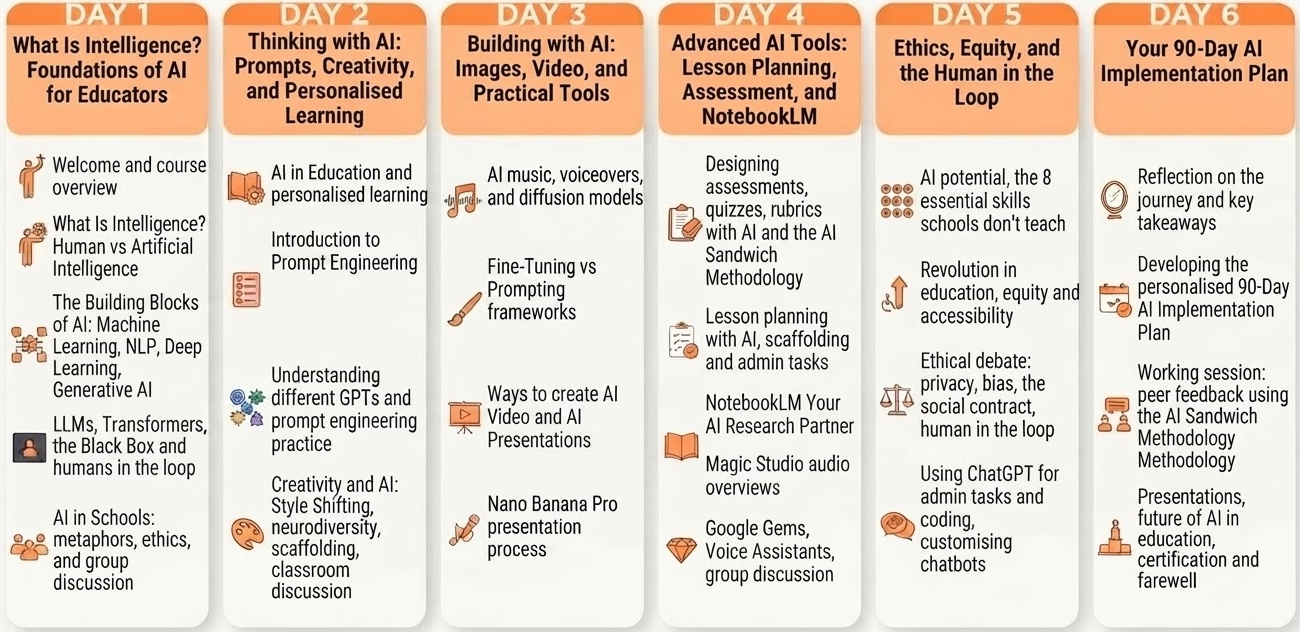
9:00–9:30: Welcome, introductions, and course overview.
9:30–10:30: What Is Intelligence? Defining human and artificial intelligence, the probabilistic nature of both, and why it matters.
10:45–11:00: Coffee break.
11:00–12:00: The Building Blocks of AI: Machine Learning, NLP, Deep Learning, and Generative AI — how they connect and why they matter in education.
12:00–13:00: LLMs, Transformers, GPTs, and the Black Box: What actually happens inside AI systems, and why a human must always be in the loop.
13:00–14:00: AI in Schools: the stochastic parrot, the cave wolf, the black box — metaphors, ethics, and group discussion on AI’s potential and risks.
-
9:00–10:00: AI in Education: personalised learning, learning at your own pace, and how AI is changing what students need to know.
10:00–11:00: Introduction to Prompt Engineering: the T-C-R-E-I, R-O-S-E, and S-C-E-T frameworks. Build your own detailed prompt.
10:45–11:00: Coffee break.
11:00–12:00: Understanding different GPTs and their strengths. Simple vs. detailed prompts. Prompt engineering practice.
12:00–14:00: Creativity and AI: the Creativity Showdown, why constraints unlock creativity, Style Shifting for diverse learners, neurodiversity, and scaffolding with AI. Discussion: how could personalised AI change your classroom?
-
9:00–10:00: Horizontal vs. Vertical AI Transformation. How diffusion models and GANs create images. AI vs. Real: Can you tell the difference?
10:00–11:00: Image prompting practice. Fine-Tuning vs. Prompting: understanding the difference and when to use each.
10:45–11:00: Coffee break.
11:00–12:00: Ways to create AI Video. Video prompting, case studies, and AI Presentations & Graphics.
12:00–14:00: AI music, voice overviews, and audio enhancers. AI Presentation Process with Nano Banana Pro & Google Slides. Hands-on creation and peer showcase.
-
9:00–10:00: Designing assessments, quizzes, and grading rubrics with AI. The AI Sandwich Methodology: keeping humans in the driver’s seat.
10:00–11:00: Lesson planning with AI: advanced templates, scaffolding for diverse learners, and using AI for administrative tasks.
10:45–11:00: Coffee break.
11:00–12:30: NotebookLM: Your AI Research Partner. Exploring all Magic Studio features: audio overviews, guides, timelines, and practice.
12:30–14:00: Google Gems: creating a Gem and why it empowers teachers. Voice Assistants and AI. Group discussion: adapting teaching methods with AI.
-
9:00–10:00: Do we understand AI’s incredible potential? The problem with traditional education and the 8 essential skills schools don’t teach.
10:00–11:00: The biggest revolution AI brings to education: failed incentives, the machine and free will, and what equity and accessibility really mean.
10:45–11:00: Coffee break.
11:00–12:30: Ethical debate: AI in schools, privacy, bias, the social contract, and “a human must be in the loop.” Group-led discussion and reflection.
12:30–14:00: Using ChatGPT for administrative tasks and coding with AI. Customising educational tools and chatbots for your context.
-
9:00–9:30: Welcome to Day 6. Reflecting on the full learning journey and identifying key takeaways.
9:30–10:30: Developing your personalised 90-Day AI Implementation Plan: setting goals, choosing tools, and mapping your first steps.
10:30–10:45: Coffee break.
10:45–12:00: Working session: building and refining your 90-Day Plan. Peer feedback and facilitator input using the AI Sandwich Methodology.
12:00–13:00: Presentations: each participant shares their plan and one key tool or approach they are taking back.
13:00–13:30: Exploring the future of AI in education: what’s coming, what’s possible, and what it means to keep the human in the loop.
13:30–13:45: Certificate Awarding Ceremony.
13:45–14:00: Closing session and farewell.
What Participants Take Back
- A clearer understanding of the ethical implications and biases present in AI tools used in education.
- Practical strategies to integrate AI-powered tools in ways that support inclusion and equity.
- The ability to identify and address bias in AI-generated content before using it with learners.
- Experience adapting AI-assisted materials to create customised, accessible learning resources.
- Tools and practical routines to use AI for enhancing students’ writing and detecting plagiarism fairly.
- Stronger confidence in talking to students and colleagues about AI, fairness and responsible use.
- Concrete ideas for classroom activities that help learners think critically about AI and media.
- A personal action plan for introducing or improving AI-supported teaching practices in their own institution.
Course Format
Duration: 5-6 training days.
Daily workload: 4–5 hours per day, Monday to Friday, with optional cultural or networking activities depending on the location.
Language: English.
Language requirement: participants should have at least an A2/B1 level of English to actively follow the training and take part in discussions and practical work.
Digital level: no advanced IT knowledge is required for this course; basic confidence using a laptop and online tools is enough. Previous experience with AI tools is a plus, but not necessary
Equipment: participants must bring their own laptop, as devices are not provided during the training.
Target groups: teachers, trainers, school leaders, adult educators, VET staff, Erasmus+ coordinators, and other education professionals.
Adaptation: course examples and activities are adapted to the profile, experience, and educational context of the enrolled group whenever possible.
Funding fit: this course is designed to align with Erasmus+ KA1 staff mobility priorities for SCH, ADU and VET participants.
Course Fee
€80 per participant, per training day
This course fee is designed to align with Erasmus+ KA1 staff mobility funding for eligible SCH, ADU and VET participants.
Included in the course fee:
✔Tuition and training materials
✔Pre-arrival information
✔Location infopack
✔Coffee break
✔Training Certificate
✔Europass Certificate
✔Administrative and organisational support related to the course
Travel and Stay Support
We support participants with practical guidance before arrival so they can organise their mobility with more confidence.
We suggest:
✔Accommodation options such as hotels and apartments,
✔Local transportation information, and, airport transfer options,
✔ Half-day and full-day trip ideas, cultural activities and useful local recommendations.
These services are not directly provided by Colony of Creators unless explicitly confirmed in advance, but we do help participants identify the most suitable options for their stay and make the most of their Erasmus+ experience.
100% funded by the Erasmus Plus Program through your Erasmus+ SCH, ADU or VET grant.
Eligible institutions may use Erasmus+ KA1 mobility funding to cover course-related costs according to their approved budget and funding rules.
Request Information About This Erasmus+ AI Course
If you are a teacher, trainer, school leader or Erasmus+ coordinator interested in Smart Teaching: AI-Driven Solutions with ChatGPT and Beyond, use this form to request course details, dates, group options or support for Erasmus+ planning.