Why a Stronger Budget Will Transform Youth Futures (26.2B to 40.8B)
The reality is that the Erasmus+ program is recognized as one of the most successful and transformative initiatives of the European Union, driving educational mobility, cross-border cooperation, and social cohesion.
Experiences gathered over decades by Europeans (and not only) show that international mobility projects do far more than just facilitate academic exchange.
They truly serve as critical mechanisms that establish structured professional pathways, restore civic confidence, and build enduring transnational networks. This reflects especially reflected in the young ones, where youth joining Erasmus+ mobilities have a chance to grow personally, socially, and culturally. They create friendships with other countries, start developing themselves, and realize that their voice matters. As such, it has truly been proving for the past 37 years that the program is beneficial and is believed to have the most impact as an educational program across Europe.
On July 16, 2025, the European Commission officially presented its proposed regulation for the next generation of the Erasmus+ program, spanning for the next seven-year period from 2028 to 2034.
The proposal is currently undergoing intense negotiations among the European Parliament, the Council, and the Commission, yes the holy trinity of EU.
Discussions involve introducing fundamental designs and better structural modifications to the program's architecture, funding mechanisms, and priority areas. One might argue that the arrival of AI is one of the influences that calls for better-structured and better-funded mechanisms to be assessed and developed, keeping in mind the tools we have at our fingertips.
For schools, non-governmental organizations (NGOs), adult training centers, and civil society actors, understanding this upcoming transition is essential to prepare and align strategic plans before the new cycle begins on January 1, 2028. Treat the Erasmus+ Guide as a “bible” we can’t stress that enough.
The evolution of the Erasmus+ programme occurs within the broader context of the €2 trillion Multiannual Financial Framework (MFF) proposed for 2028–2034. This long-term EU budget is designed to address pressing geopolitical, competitiveness, and environmental challenges.
By positioning Erasmus+ as a central pillar of this future-oriented strategy, the European Commission seeks to double down on skills development, civic resilience, and social inclusion across the continent.
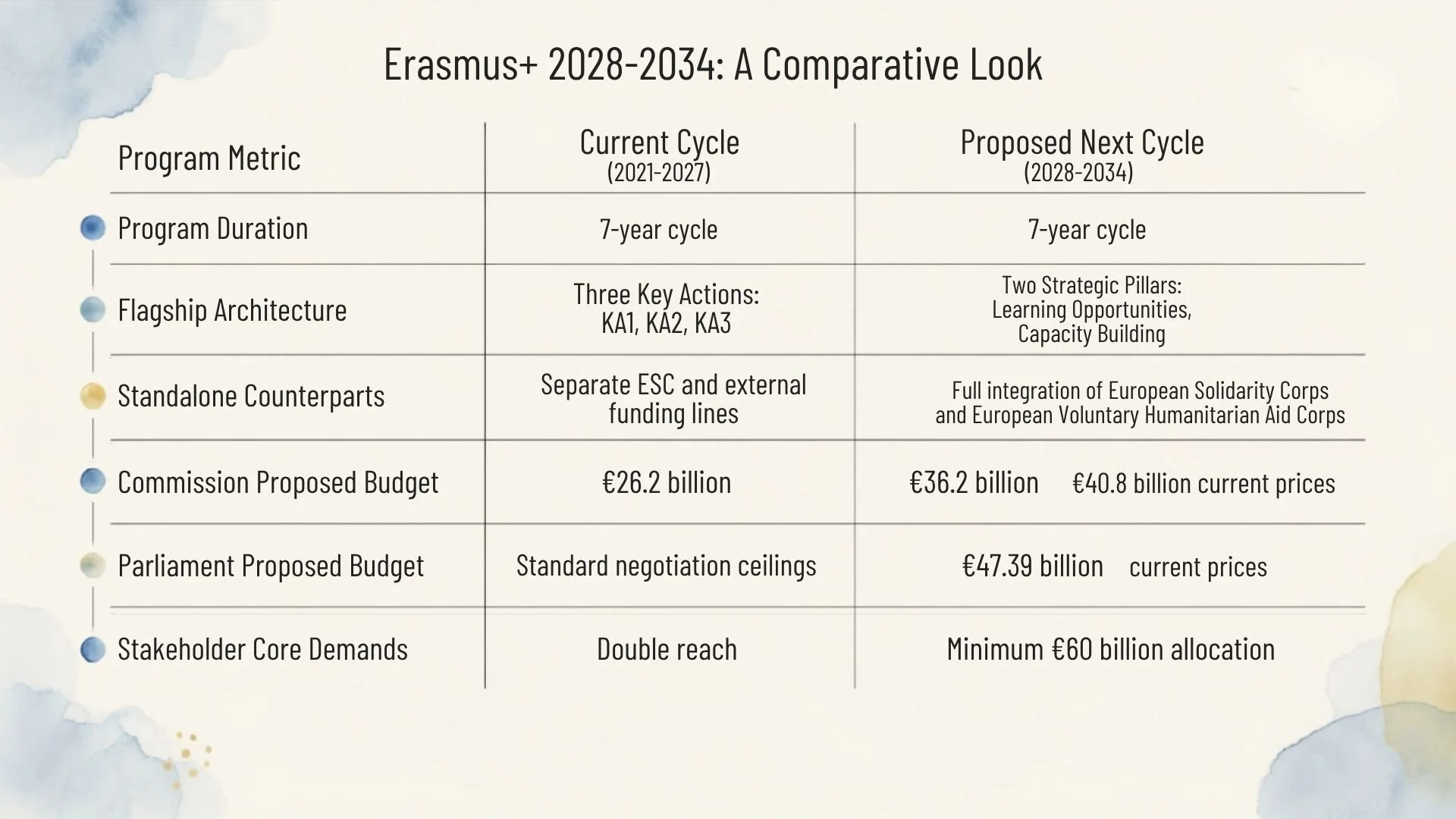
The comparison between the proposed program changes illustrates this shift in scale and structure:
What is Being Proposed for the next Erasmus+ Term
(2028–2034)?
For 2028–2034, the Erasmus+ program aims to simplify, streamline, and consolidate the European Union's education and youth fundings. Under the new MFF architecture, the Commission aims to reduce the overall fragmentation of funding streams by consolidating several independent initiatives into unified programs operating under shared rulebooks.
The core goal is to fix a "too many cooks in the kitchen" problem by merging separate funding pots and rule sets into a more coherent system.
An example of this is the decision to merge the standalone European Solidarity Corps (ESC), including the European Voluntary Humanitarian Aid Corps, directly into the Erasmus+ framework. This merger aims to establish a single, coordinated entry point for young people and organizations looking to access EU volunteering, solidarity, and educational opportunities.
The proposed indicative is of a budget of €40.8 billion, designed to support the ambitious strategic targets outlined in the European Education Area (EEA) and the Union of Skills initiatives.
The general objectives of the next-generation program are to promote quality lifelong learning and enhance lifeand labor market skills. The Commission's proposal aims to expand learning mobility to all individuals from an early age, introducing systematic mobility windows across all fields of education, vocational training, youth, and sport.
How Numbers & Structures Changed Since 2021–2027
To understand the reality of the proposed budget increase, let’s contrast the new proposals with the baseline of the current 2021–2027 period. The current Erasmus+ program operates with a seven-year budget of €26.2 billion.
When looking at the numbers, the proposed €40.8 billion for 2028–2034 represents an increase of more than 50%. However, the European Parliament and academic bodies note that because the European Solidarity Corps (ESC) is being integrated into the next program term, a realistic comparison must combine the current budgets of both independent programs.
Let me explain:
To see the true change in funding, you can't just compare the new single budget to the old Erasmus+ budget alone. You must compare it to the combined total of what was previously spent on both programs.
Current Combined Budget (2021-2027): Erasmus+ (€26.2B) + European Solidarity Corps (€1.0B) = €27.2 billion.
Proposed Future Budget (2028-2034):€40.8 billion (which now includes ESC activities).
The combined budget of Erasmus+ and the ESC under the current MFF is €27.7B. Therefore, the Commission's proposal of €36.2 billion in 2025 prices reflects more of an increase of approximately 30% and not the 50%.
While a 30% increase is significant, several stakeholders and policy advocates argue that this envelope remains insufficient to meet the geopolitical and economic challenges facing Europe.
For example, the report on the Future of European Competitiveness prepared by Mario Draghi highlights that to successfully address systemic labor shortages and accelerate the green and digital transitions, the European Union should ideally quintuple the resources allocated to Erasmus+.
Furthermore, a joint statement supported by the European University Association (EUA) has called on EU decision-makers to secure a minimum budget of €60 billion. The argument is that, that after adjusting for growing inflation, across Europe, and the financial demands towards new initiatives, a lower budget would at best allow the program to maintain its current scale.
What These Changes Mean
Under the next program, mobility opportunities are to be linked directly to strategic industries and sectors experiencing labor shortages. The proposal introduces dedicated support for micro-credentials, allowing learners and young professionals to accumulate shorter, flexible, and formally recognized training modules throughout their careers.
This is particularly relevant for the vocational education and training (VET) sector, where the integration of elective mobility windows into curriculum standards is designed to raise the overall quality and prestige of practical training tracks.
By facilitating early-stage mobility for apprentices, pupils, and young workers, the program aims to cultivate a culture of lifelong learning and adaptive professionalism from the start of an individual's career.
Why We Benefit From A Larger Erasmus+ Budget
Non-governmental organizations and youth associations operate at the frontline of educational policy implementation, using European grants into localized training and social integration programs. For these, the Erasmus+ program is an indispensable tool to run high-quality mobility projects, provide non-formal education, and support young people who have struggled to succeed in traditional academic settings.
We in our work, demonstrate how structured international mobility and volunteering projects can and have changed lives. When a young person coming from a rural city in Madeira (for example) participates in a six-week vocational internship, an ESC project managed by a local NGO, that experience serves as a turning point in that person’s life.
Through direct, hands-on learning and peer-to-peer mentoring, participants develop essential soft skills and transversal skills such as crisis management, team communication, and self-organization—that are rarely taught in traditional classrooms. That’s the reality!
The structural shift of the 2028–2034 program is built around two primary pillars designed to offer a leaner and more integrated menu of opportunities for all participating organizations.
Here’s an Overview:
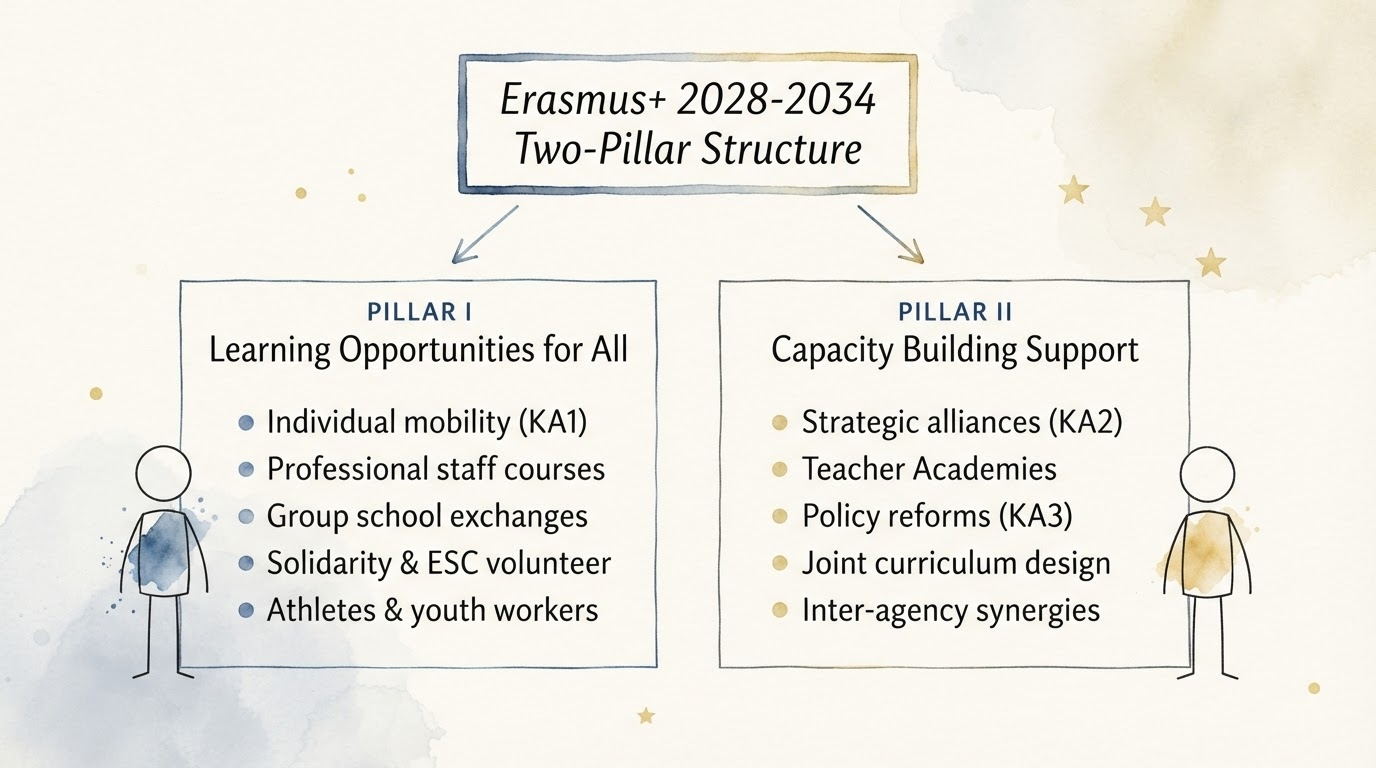
Within Pillar I: Learning Opportunities for All, institutions can access funding for structured training courses, job shadowing, and teaching assignments for school, VET, and adult education staff. This also encompasses group student exchanges, youth volunteering, DiscoverEU initiatives, and newly introduced mobility opportunities for grassroots sports coaches and athletes.
Furthermore, the integration of ESC volunteer programs under this pillar ensures that active citizenship and humanitarian aid volunteering remain fully supported under a single application framework.
Within Pillar II: Capacity Building Support, organizations can engage in transnational partnerships to create and design more of innovative educational methodologies, update curricula, and implement systemic reforms into their programs.
This also means including participation in initiatives such as European University Alliances, Centres of Vocational Excellence, and European Teacher Academies, which will receive targeted resources to strengthen professional development networks across member states.
In conclusion, the transition to the 2028–2034 Erasmus+ program represents more of a strategic repositioning of the European Union's primary investment in its people.
By consolidating structures, expanding budgets, and focusing on practical skills development, the new program is designed to equip the future generation with the tools required to navigate a rapidly changing economic and geopolitical world.
For training networks, schools, and NGOs, the coming months are critical to audit internal capabilities, build secure partnerships, and align strategic objectives with the two-pillar framework.
By taking these preparatory steps, the European educational sector will ensure it stands ready to translate this public investment into immediate, life-changing opportunities for millions of learners across Europe.