Critical Thinking and Creativity for Democratic Participation
Why This Course Matters
Learners today are surrounded by constant information, strong opinions and fast-moving digital content. They need more than subject knowledge. They need the ability to question information, evaluate different perspectives, think independently and participate responsibly in democratic life.
This course helps educators create learning environments where critical thinking and creativity work together. Over 6 days, participants explore how to strengthen reflection, discussion, collaboration and active citizenship through practical classroom activities and participatory methods.
Participants learn how to support respectful dialogue, develop media literacy, encourage learner voice and design activities that connect creativity with civic engagement. The focus is on practical strategies that can be adapted to different age groups, educational settings and Erasmus+ project goals.
By the end of the course, participants leave with ready-to-use ideas, stronger facilitation strategies and a clearer approach to building democratic participation through education.

What Participants Learn
- How critical thinking, divergent thinking, convergent thinking and lateral thinking support democratic participation and active citizenship in education.
- Practical classroom activities that help learners question information, recognise bias and evaluate different perspectives.
- Ways to use selected lateral thinking techniques and simple creative methods to support collaborative problem-solving.
- How to apply Austin Kleon’s “Steal Like an Artist” ideas responsibly to help learners generate, remix and refine creative civic projects.
- Strategies for building media literacy and helping learners engage more critically with information and public debate.
- Techniques for facilitating respectful dialogue, active listening and constructive disagreement in diverse classrooms.
- Approaches to work with communication styles, nonverbal communication, empathy, assertiveness and anger management in group work and discussions.
- Methods from Council of Europe resources such as Compass and All Different – All Equal to promote participation, human rights and active citizenship.
- Ways to design learner-led projects, class councils, debates and creative campaigns that give students real influence in classroom and school life.
How the Course Works
- Hands-on learning from Day 1 using discussion, reflection and participatory activities rather than digital tools.
- Short input on key concepts and frameworks, followed by practical exercises and small-group work.
- Guided use of divergent, convergent and lateral thinking to explore classroom issues, social challenges and democratic participation.
- Creative activities inspired by Austin Kleon’s “Steal Like an Artist” and selected lateral thinking techniques to support idea generation and problem-solving.
- Integration of human rights and participation activities based on Compass and All Different – All Equal.
- Role-play, simulations and collaborative tasks that build dialogue skills, empathy, assertiveness and emotional regulation.
- Space for participants to adapt all activities to their own age groups, subjects and educational settings.
- Continuous facilitation and feedback to help participants turn course content into realistic classroom and school practices.
-
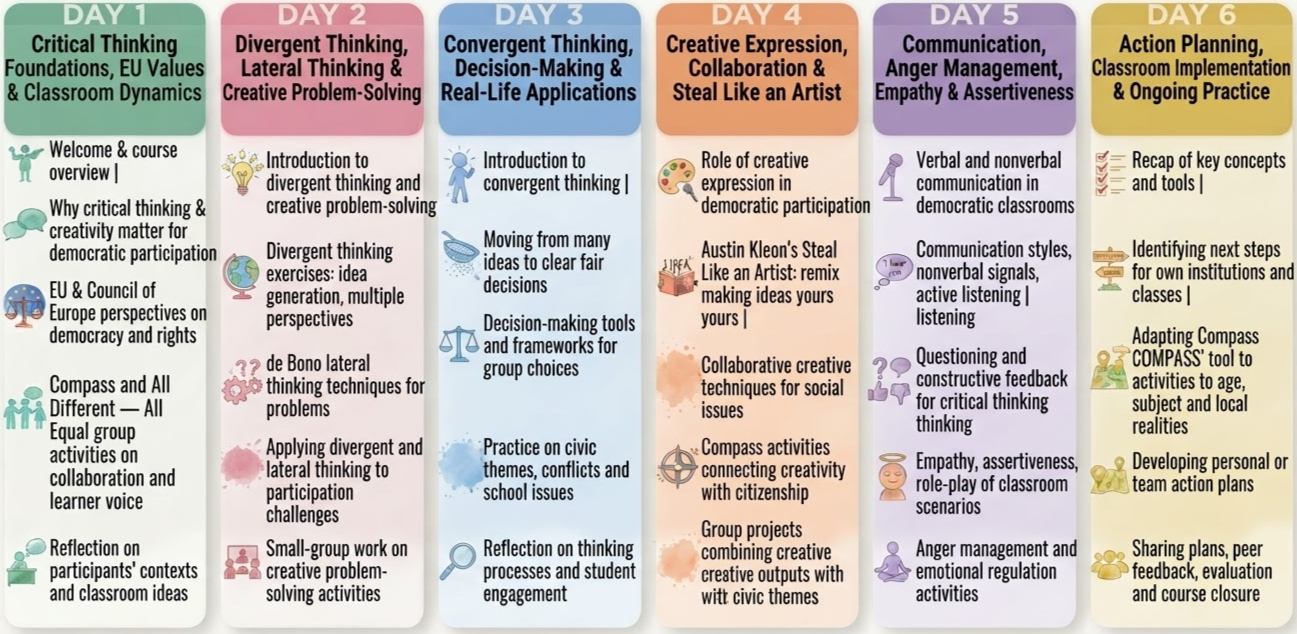
09:00–09:30 | Welcome, course overview and introductions
09:30–10:15 | Why critical thinking and creativity matter for democratic participation and classroom dynamics
10:15–10:30 | Coffee break
10:30–11:00 | EU and Council of Europe perspectives on democracy, human rights and participation
11:00–12:00 | Exploring key competences for democratic culture (values, attitudes, skills) through practical examples
12:00–13:00 | Group activities inspired by Compass and All Different – All Equal to reflect on collaboration, responsibility and learner voice
13:00–14:00 | Reflection on participants’ own contexts and first ideas for classroom activities
-
09:00–09:30 | Recap and introduction to divergent thinking and creative problem-solving
09:30–10:15 | Divergent thinking exercises: idea generation, multiple perspectives and “what else?” questions
10:15–10:30 | Coffee break
10:30–11:00 | Lateral thinking basics and selected de Bono techniques for approaching classroom and social problems differently
11:00–12:00 | Applying divergent and lateral thinking to democratic participation challenges and student projects
12:00–13:00 | Small-group work designing creative problem-solving activities for learners
13:00–14:00 | Sharing and refining ideas for use with different age groups and contexts
-
09:00–09:30 | Recap and introduction to convergent thinking
09:30–10:15 | Moving from many ideas to clear decisions while balancing fairness, inclusion and classroom realities
10:15–10:30 | Coffee break
10:30–11:00 | Decision-making tools and simple frameworks for group choices in real-life school and community situations
11:00–12:00 | Practising convergent thinking on civic themes, everyday conflicts and school-related issues
12:00–13:00 | Activities where learners prioritise, select and justify options related to democratic participation and problem-solving
13:00–14:00 | Reflection on how these thinking processes affect classroom dynamics and student engagement
-
09:00–09:30 | Recap and the role of creative expression and collaboration in democratic participation
09:30–10:15 | Austin Kleon’s “Steal Like an Artist” principles: learning from influences, remixing and making ideas your own
10:15–10:30 | Coffee break
10:30–11:00 | Collaborative creative techniques for exploring social issues, identity and community through art, writing and media
11:00–12:00 | Using Compass-style activities to connect creative work with rights, responsibilities and active citizenship
12:00–13:00 | Group projects that combine creative outputs with civic themes (posters, campaigns, stories, performances)
13:00–14:00 | Sharing projects and feedback with a focus on collaboration and constructive critique
-
09:00–09:30 | Recap and introduction to verbal and nonverbal communication in democratic classrooms
09:30–10:15 | Foundations of communication: communication styles, nonverbal signals and their impact on participation
10:15–10:30 | Coffee break
10:30–11:00 | Strategies and techniques for promoting critical thinking through questioning, active listening and constructive feedback
11:00–12:00 | Activities to develop empathy and assertiveness, including role-play of common classroom and participation scenarios
12:00–13:00 | Practical approaches to anger management and emotional regulation in group work and discussion
13:00–14:00 | Reflection on communication, emotions and how they shape classroom dynamics and democratic processes
-
09:00–09:30 | Recap of key concepts: divergent, convergent and lateral thinking, creativity, communication and participation
09:30–10:15 | Identifying concrete next steps for participants’ own institutions and classes
10:15–10:30 | Coffee break
10:30–11:00 | Adapting activities from Compass and All Different – All Equal to specific age groups, subjects and local realities
11:00–12:00 | Developing personal or team action plans that integrate critical thinking, creative problem-solving and democratic participation
12:00–13:00 | Practising active listening and assertive communication while sharing implementation plans and receiving peer feedback
13:00–14:00 | Final reflection, evaluation and course closure
What Participants Take Back
- A clear understanding of how different thinking processes (critical, divergent, convergent and lateral) can strengthen democratic participation in education.
- Ready-to-use classroom activities that help learners question information, recognise bias and evaluate perspectives.
- Practical exercises based on selected lateral thinking tools and “Steal Like an Artist” principles for creative exploration and problem-solving.
- Human rights and participation activities adapted from Compass and All Different – All Equal for their own contexts.
- Strategies to facilitate respectful dialogue, active listening and constructive disagreement in classroom discussions.
- Approaches to address communication styles, nonverbal communication, empathy, assertiveness and anger management in group work.
- Concrete ideas for learner-led projects, class councils, debates and creative campaigns that promote active citizenship.
- A personal action plan for integrating critical and creative thinking for democratic participation into lessons, school projects and Erasmus+ activities.
Course Format
- Duration: one-week course (5-6 training days). Alternative formats may be available on request.
- Daily workload: 5-6 hours per day, from 09:00 to 14:00, with one coffee break and several short transitions between activities.
- Language: English.
- Language requirement: participants should have at least an A2/B1 level of English to actively follow the training and take part in discussions and practical work.
- Digital level: no specific digital skills are required. This course focuses on dialogue, group work, and activity-based methods rather than digital tools.
- Equipment: participants are not required to bring laptops or tablets. Materials needed for activities (paper, markers, cards, etc.) are provided
- Target groups: teachers, trainers, youth workers, adult educators, school leaders, and other education professionals.
- Adaptation: examples and activities are adapted to participants’ areas of work, age groups and institutional contexts whenever possible.
- Funding fit: this course is designed to align with Erasmus+ KA1 staff mobility funding for SCH, ADU and VET participants, according to their approved budget and funding rules.
Course Fee
€80 per participant, per training day
This course fee is designed to align with Erasmus+ KA1 staff mobility funding for eligible SCH, ADU and VET participants.
Included in the course fee:
✔Tuition and training materials
✔Pre-arrival information
✔Location infopack
✔Coffee break
✔Training Certificate
✔Europass Certificate
✔Administrative and organisational support related to the course
Travel and Stay Support
We support participants with practical guidance before arrival so they can organise their mobility with more confidence.
We suggest:
✔Accommodation options such as hotels and apartments,
✔Local transportation information, and, airport transfer options,
✔ Half-day and full-day trip ideas, cultural activities and useful local recommendations.
These services are not directly provided by Colony of Creators unless explicitly confirmed in advance, but we do help participants identify the most suitable options for their stay and make the most of their Erasmus+ experience.
100% funded by the Erasmus Plus Program through your Erasmus+ SCH, ADU or VET grant.
Eligible institutions may use Erasmus+ KA1 mobility funding to cover course-related costs according to their approved budget and funding rules.
Request Information About This Erasmus+ AI Course
If you are a teacher, trainer, school leader or Erasmus+ coordinator interested in Smart Teaching: AI-Driven Solutions with ChatGPT and Beyond, use this form to request course details, dates, group options or support for Erasmus+ planning.